


A pen rests atop a printed document displaying financial or billing information.

News
March 10, 2026

Doctors going unpaid as OHIP flags 1M-plus claims a year

Fix needed now for taxpayer-funded health plan

Ontario doctors are providing urgent health-care procedures, without pay, to accident victims, newborns, unhoused people and other vulnerable patients, as an antiquated and flawed OHIP billing system flags more than one million claims a year.

In one case, a surgeon spent 15 hours in 2022 reattaching four fingers to a farmer’s hand after it was crushed in an equipment accident. After OHIP rejections and multiple appeals for review and common sense, it took three years for the surgeon to be compensated for this critical work that meant the difference between a patient resuming their work or suffering through a life-changing injury.

In November of 2022, I treated a farmer whose hand had been crushed in equipment, partially severing four of his fingers. We reattached these in a surgery that took over 15 hours. This was difficult work done under the operating room microscope overnight.

Afterwards, I submitted my bill to the government and was paid $0. 3 years later, this gentleman has successfully returned to farming with all four of his fingers intact, and I still have been paid $0.

The province doesn't recognize the importance of preserving one's dignity when it comes to breast cancer care. Just this past month, the province has refused to pay for the surgical care of three women who underwent removal of their breast while preserving the outer breast skin and nipple. They tell me a surgery that takes three times as long, years of additional training and expertise isn't worth paying for.

I do a lot of high-end advanced sinus and skull-based surgeries in my practice. For so many years it has been an incredible frustration to get these cases paid by the Ministry of Health. Over and over again, we have to submit claims once, twice, and three times or even more to finally get paid. This is a huge burden of administrative work for me and for my staff and is this just isn't fair.

If I do a complex surgery that requires multiple codes in order to highlight or encompass the entire procedure, this automatically goes to manual review which is reviewed by non-specialist. Often this review will take 6 to 9 months and there'll be a number of codes rejected. Therefore I'm not really being paid adequately or appropriately for these complex surgeries. This certainly makes me reconsider whether or not these surgeries are something that I should be offering in my practice.

Like all pediatricians, I willingly care for newborn infants, trusting that any baby born in Ontario automatically has OHIP coverage. So, it's demoralizing to find out many weeks later that my billing has been denied by the Ministry of Health. I'm providing care, but the province isn't always paying the bill.
“This was difficult work done under the operating room microscope overnight,” recalls Dr. Braden Gammon, director of the University of Ottawa Hand Fellowship Program.

“Afterwards, I submitted my bill to the government and was paid $0. Three years later, this gentleman has successfully returned to farming with all four of his fingers intact, and I still had been paid $0," says Dr. Gammon.

After his claim was rejected by the Ministry of Health, Dr. Gammon had to relentlessly advocate for payment through multiple emails and phone calls, and five resubmissions. He was not paid anything until June 2025.

Pediatricians are also routinely denied claims for care provided to newborns when there has been a delay in registering the baby’s official health card at Service Ontario.

“It makes me feel very frustrated,” says Dr. Jane Healey, a pediatrician based in Mississauga, Ont., and the OMA's section chair of pediatrics.

For example, during a postal strike one year, 56 of Dr. Healey’s claims for newborn care were rejected because the infants’ registration forms did not reach the OHIP offices, and then expired.

“This problem doesn’t exist in every province. Ontario has chosen this very cumbersome process with multiple failure points that are completely outside the physician’s control," says Dr. Healey.

When OHIP rejects newborn claims, the government expects doctors to track down parents and direct them to Service Ontario to correct the health-card registration. This is a time-consuming inconvenience for doctors and new parents.

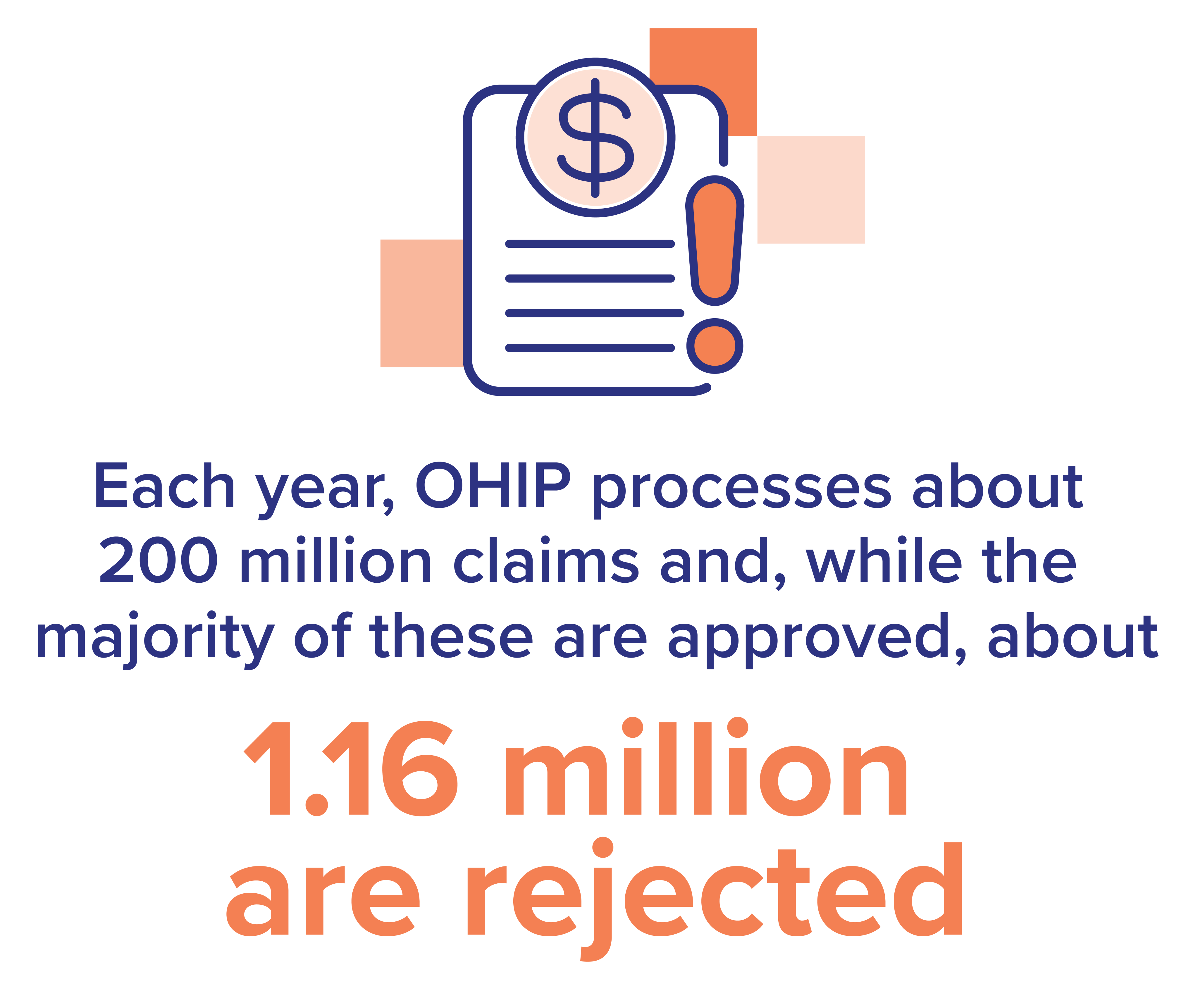
Doctors who treat unhoused patients also go unpaid when the person’s health card number is ruled invalid because they’ve moved shelters and have not updated the address on their health card.An graphic from the Ontario Medical Association stating that each year, OHIP processes about 200 million claims, and about 1.16 million are rejected.

“About a third of our patients are homeless,” says Dr. Chris Cavacuiti, an addiction doctor at trueNorth Medical Centre.

“(Unhoused patients) really, really struggle to maintain valid health coverage because health coverage is tied to having an address,” says Dr. Cavacuiti.

Dr. Cavacuiti says homeless patients are forced to go through a three-to-six-month process to update their health cards.

“During that entire period, their coverage is invalid. Many patients fall through the cracks and never finish the renewal process,” he says. 

“Even for those who do, coverage is rarely retroactive — even when there’s clear proof they were living in Ontario. That means physicians aren’t paid for months of care. It’s outrageous.” 

Red tape can lead to payment delays, denials

To receive payment for their services, Ontario physicians must first submit a claim to OHIP. The taxpayer-funded health plan is then responsible for reviewing doctors’ claims and making decisions on what care is funded. If a claim doesn’t conform to OHIP’s often-complex rules, it can be denied.

Most appeals are resolved in about 30 days, but about 58,000 claims can take months to several years to yield payment for doctors. That’s about 1,000 cases a week.

These figures, however, hide the many cases where doctors don’t submit claims for their work in the first place because the added bureaucracy takes precious time away from patient care.

Dr. Mojola Omole, a breast surgical oncologist and general surgeon at Toronto’s Scarborough Health Network, often has claims rejected in cases involving plastic surgery and breast reconstruction, and when a patient receives more than one procedure.

Challenging these OHIP decisions is time-consuming — and often unsuccessful.

“Instead of me spending hours trying to talk to someone at the ministry, I would just submit something that I know will go through, even though it does not encompass all the work that I’ve done,” says Dr. Omole.

These are just a few examples that illustrate a health insurance plan that is out of date and fails to recognize the complexity of many medical procedures and surgeries. Ontario’s doctors are calling for an urgent overhaul.

Dr. Warren Latham, chief of orthopedics at Scarborough Health, says complex surgeries require him to submit a claim to OHIP encompassing multiple parts. This triggers an automatic review by non-specialists, which can take six to nine months. Most often, several parts of his claim are ultimately rejected.

“I’m not being paid adequately or appropriately for these complex surgeries,” he says. “This certainly makes me reconsider whether or not these surgeries are something that I should be offering in my practice.”