

FHO+ is the future of family medicine
Hello.
My name is Dr. Nicolina Mizdrak and I'm the chair of the Negotiations Task Force (NTF).
At the OMA, I want to share a number of details about the new FHO+ (family health organization plus) model that will provide a substantial compensation increase for doctors practising longitudinal family medicine.
For years, family physicians have told us that they're struggling with unpaid administrative work and the increasing complexity of patients. We've also heard that current models don't do enough to support equity when it comes to gender and workload. And of course, we've heard time and time again that negation is a major, major pain point.
I'm a FHO doctor myself and I've experienced these challenges firsthand based on consultation with members and a co‑designing effort with SGFP (Section of General and Family Practitioners). We've been working on a plan to build a strong future for family medicine in Ontario, and it's based on reforming the Family Health Organization model to create what we're calling FHO+.
Before going into details, I want to note that some aspects of FHO+ are still in arbitration, but we've reached agreement with the ministry on many key components.
Here are the fundamental aspects that go into compensation under the FHO+ model: Under the FHO+ model doctors will keep the existing capitation payment. There will be significant increases to both shadow billing
and after‑hours premiums. The new major addition is time‑based billing. That means getting paid an hourly rate for all direct and indirect care.
This has many large benefits. You'll be paid for administrative work
and indirect care, such as reviewing lab results, and when you spend more time on a complex patient, you'll be compensated for it.
This model will address the gender pay gap and studies show that female physicians tend to spend more time with each patient encounter.
What you don't see in the graphic is the CCM (comprehensive care model) fee
and the access bonus. The hourly rate required a large investment,
and we were able to obtain new funding for it. We needed to supplement that with the funding that's been used for the access bonus and the CCM fee.
For the vast majority of FHO physicians, this will be a clear benefit and with the end of the access bonus comes the end of negation as well.
Let me explain how that will work out in a practice with an example. Let's take a full‑time physician with a roster
of 1,220 patients who completes
around 62 visits per week and works around 26 hours.
Under the current FHO model,
they would earn just under $390,000.
Under FHO+ they'll earn $439,000.
That is an increase of 13%.
The new hourly rate, increased shadow billing,
and increases to the schedule more than make up
for the CCM and the access bonus.
You can find the full details on this scenario on our website,
along with scenarios for physicians with smaller
and larger rosters.
In all three cases, our modelling shows
that FHO+ will be a major benefit.
What we haven't agreed to
with the ministry is accountability.
Our position is that there does not
need to be an accountability measure.
The FHO model itself is the measure.
However, we do know from our discussions with the arbitrator
that he favours some accountability measures.
Based on our conversations with you,
we focused the discussion on making sure this would only
penalize the low performers—meaning those
who have a low volume of visits
and time that they're billing.
We will see where the arbitrator rules.
We are confident that those of us who put in the effort
to see our patients regularly will not
be impacted by the measure.
I also want to emphasize, once again, this is currently going
to arbitration and there is a long way to go
before the new model will be put into place.
That will likely happen sometime in 2026.
Leading up to implementation, we will provide you
with much more information about FHO+, along with tools
and resources to help you effectively bill for your work.
We know billing will be a particular challenge,
so we're working with OntarioMD on a solution
that would enable you to easily bill your time.
I'm very excited about FHO+, and I hope you are too.
We, the Negotiations Task Force, sincerely appreciate the collaborative work we
have done with the SGFP in developing this FHO+ model.
I look forward to providing you with more updates
as we work toward the changes
to incentivize longitudinal family medicine.
Thank you for watching.
Family medicine is in crisis, and we’re building solutions.
Improvements to the FHO model will address the issues that family doctors have told us about time and time again, including administrative burden, increasing complexity, the gender pay gap, and lagging compensation.
The goal: Bring back the joy of family medicine, and build a foundation to support recruitment and retention, with FHO+.
We’ve worked closely with the Section on General and Family Practice and researched best practices from other jurisdictions to create a structure that builds on the existing FHO model.
We have finalized key components of the model through negotiations with the Ministry of Health, but there are still details that will be determined through arbitration.
We anticipate existing FHOs will transition to FHO+ on April 1, 2026. All other existing family medicine models will remain in place for members who prefer them.
OMA Live webinar
OMA leaders and key members of the Negotiations Task Force laid out important details surrounding our arbitration asks in this July 9 session.
Watch the recording (member-only access)More about FHO+
Download the presentation for our recent webinars on the FHO+ model, select one of the videos below to watch on demand, or read the transcripts.
Watch July 15 webinar Watch July 16 webinarCompensation model
Funding FHO+
Payment calculator
Physician scenarios
CoC accountability
Compensation model
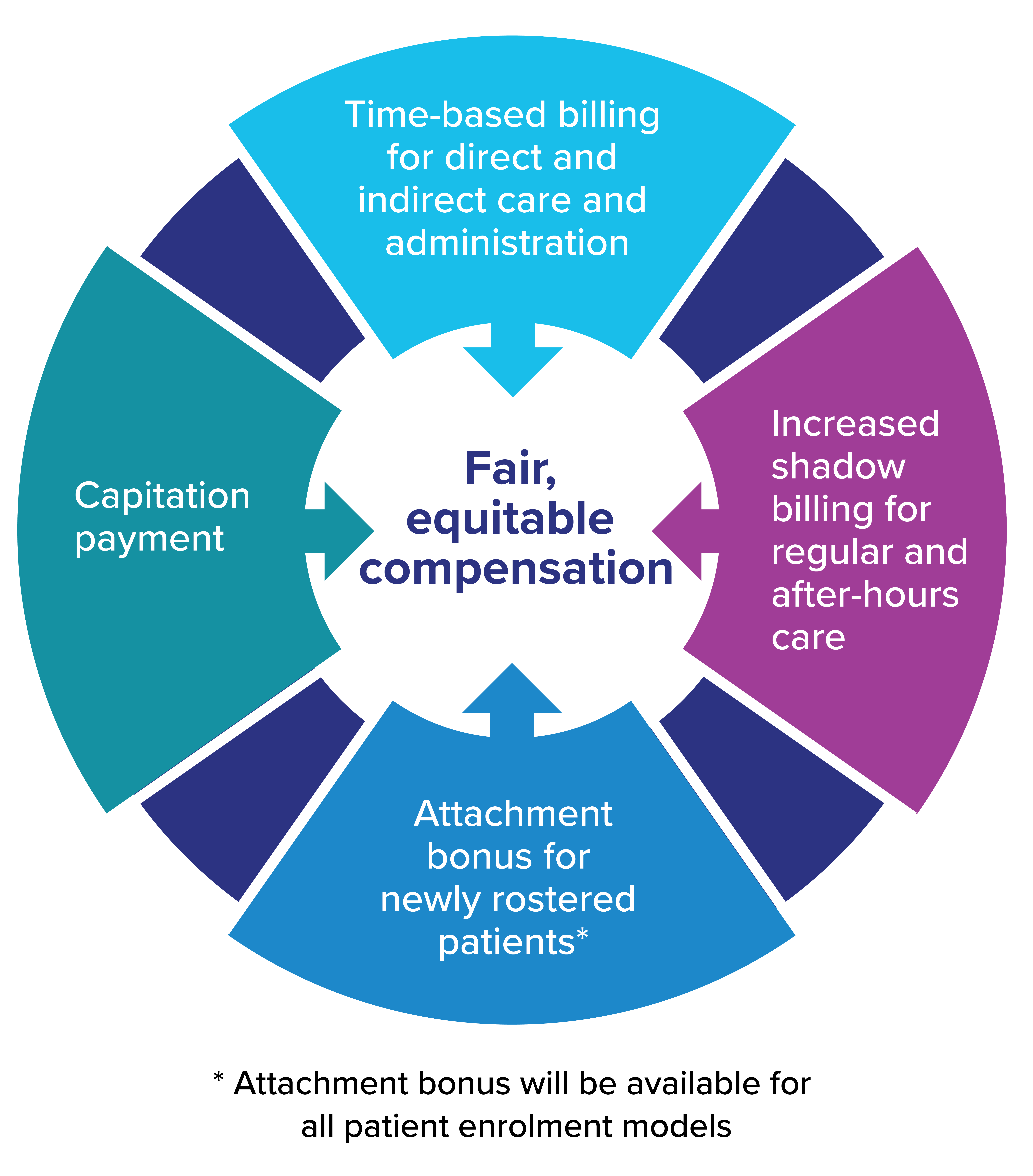
The most important improvement under FHO+ is time-based billing that pays an hourly rate for all direct and indirect care.
The benefits will be transformative. Under FHO:
- You’ll be paid for administrative work
- You’ll be paid for indirect care, such as reviewing lab results
- You’ll be compensated for the time you spend on clinical teaching, when supporting patients
- When you spend more time on a more complex patient, you’ll be compensated for it
Under FHO+, FHO doctors will also keep their existing capitation payment, and there will be significant increases to shadow billing and the after-hours premium.
Physicians will also receive a bonus for rostering unattached patients, with a higher bonus in remote areas or when the patient is older or more complex.
The attachment bonus will also be available for family physicians in other patient enrolment models. Learn more about the patient attachment bonuses (member-only access).
Time-based billing
There will be three types of work that you can bill under the hourly rate: direct patient care, indirect patient care, and clinical administration. Here are some examples of the type of work that will fall into each category.
Direct care
Providing insured clinical service to rostered patients of the FHO group in-person, through video chat or telephone. Clinical teaching provided concurrently with patient care is also considered direct care.
Indirect care
Providing services associated with the services you provide to patients of the FHO group where there is no in-person or virtual contact.
Examples:
- Charting
- Documentation
- Referrals
- Reviewing reports
- Forms
- Care coordination
Clinical administration
Time spent on activities to manage the patient panel and practice that does not fall under direct or indirect care. This must be administrative work that requires a physician’s professional expertise.
Examples:
- EMR updating and management
- Proactive patient management
- Quality improvement planning
Payment rate
The hourly rate pays $80, with one exception. Telephone-based virtual care will pay $68 per hour when the physician is not present in their clinic to deliver the service. All virtual care delivered from the clinic is paid the full $80, as is video-based virtual care provided off-site.
Billing the hourly rate
Separate time-based billing codes will be created for direct care, indirect care and clinical administration (with a fourth code specifically for telephone-based virtual care delivered outside of the clinic).
These codes will be billed in 15 minute increments.
There will be some limitations on billing the hourly rate.
First of all, there is a 14 hour daily limit.
There are also several limits that apply on a rolling basis. Within each 28 day period:
- Maximum of 240 hours are billable
- Indirect care and clinical administration can’t exceed 25 per cent of the total hours billed
- Clinical administration can be up to 5 per cent of the sum of direct care hours and indirect care hours
Guide to the hourly rate
Want to learn more? Check out our new guide to get a breakdown on the hourly rate.
Giving you the tools to succeed
Leading up to implementation, we’ll provide you with tools and resources to help you make the transition to FHO+. We know billing and record keeping will be a particular challenge, so we are working with OntarioMD on a solution that would enable you to easily bill your time.
Shadow billing
Shadow billing will increase substantially. For most in-basket services, shadow billing will rise from 19.4 per cent to 30 per cent. We also negotiated a higher 50 per cent shadow billing rate for the in-basket procedures listed below to encourage physicians to provide these services and to compensate for procedures that have higher associated costs.
| Fee code | Descriptor |
| G365A | D./T. PROC.-GYNAECOLOGY-PAPANICOLAOU SMEAR |
| G378A | D./T. PROC. GYNAECOLOGY-INSERTION OF IUD |
| G552A | D./T. PROC. GYNAECOLOGY-REMOVAL OF IUD |
| R048A | SKIN-EXC.-LOC.MALIG.INCL.BIOPSY-FACE/NECK-1 LESION. |
| R051A | INTEG.SYST.SKIN-LASER SURG.ON GR.1 TO 4 MALIG.LESIONS |
| R094A | SKIN-EXC-SIMPLE-MALIG.LESION-OTHER AREA-INCL.BIOPSY-ONE. |
| Z101A | SKIN-INC.-ABSCESS-SUBCUT.-ONE -LOC.ANAES. |
| Z110A | INTEGUMENTARY SYST.EXTEN.DEBRIBEMT ONYCHOGRYPHOTIC NAIL |
| Z113A | INTEGUMENTARY SYST.BIOPSY(S)-ANY METHODSUTURES NOT USED |
| Z114A | SKIN-INC.-FOREIGN BODY-LOC. ANAES. |
| Z116A | SURG.PROC SKIN-BIOPSY(S)ANY METHOD WHEN SUTURES USED |
| Z117A | SKIN.CHEM/CRYOTHERAPY MINOR SKIN LESIONS 1/MORE |
| Z122A | SKIN-EXC.-GROUP 4-FACE/NECK-ONE LESION-LOC. ANAES. |
| Z125A | SKIN-EXC.-GROUP 4-OTHER AREAS-ONE LESION-LOC. ANAES. |
| Z128A | SKIN-DESTRUCTION FINGER/TOENAIL PART/COMP./NAIL PLATE EXC.1 |
| Z129A | SKIN-DESTRUCTION-FINGER/TOENAIL-SIMPLE-PART/COMPL.-MULTI |
| Z154A | SKIN-SUTURE LACER.-UPTO 5CM.-FACE-TIE BLEEDERS/LAYERS. |
| Z156A | SKIN-EXC-SUT.-BENIGN LESIONS-SINGLE. |
| Z157A | SKIN-EXC-SUT.-BENIGN LESIONS-TWO LESIONS. |
| Z158A | SKIN-EXC-SUT.-BENIGN LESIONS-THREE/MORE LESIONS. |
| Z159A | SKIN-& SUBCUT-REMOVAL BY ELECTROCOAG.-SINGLE LESION |
| Z160A | SKIN-& SUBCUT-REMOVAL BY ELECTROCOAG.-TWO LESIONS |
| Z161A | SKIN & SUBCUT.-REMOVAL BY ELECTROCOAG.-THREE/MORE LESIONS |
| Z162A | SKIN-EXC-SUT.-NAEVUS-ONE. |
| Z175A | SKIN-SUTURE LACER.-5.1CM-10CM.-OTHER AREA. |
| Z176A | SKIN-SUTURE-LACERATION-UPTO 5CM. |
| Z314A | NOSE-EPISTAXIS-CHEM/ELECTROCAUTERY-UNIL. |
| Z315A | NOSE-EPISTAXIS-ANTERIOR PACKING |
| Z535A | INTESTINES-ENDOSCOPY-SIGMOIDOSCOPY W/WITHOUT ANOSCOPY |
| Z543A | ANUS-ANOSCOPY |
| Z545A | ANUS-INC. THROMBOSED HAEMORRHOID |
| Z847A | EYE-CORNEA-INCISION-REM. SINGLE EMBEDDED FOREIGN BODY LOC. |
| E542A | SKIN/SUBCUT TISSUE-INSERTION OF SUTURES OUTSIDE HOSP-ADD |
| G462A | Administration of oral polio vaccine |
| G538A | IMMUNIZATION - Other immunizing agents not listed above |
| G840A | IMMUNIZATION - Diphtheria, Tetanus, and acellular Pertussis vaccine/ Inactivated Poliovirus vaccine (DTaP-IPV) – pediatric |
| G841A | IMMUNIZATION - Diphtheria, Tetanus, acellular Pertussis, Inactivated Polio Virus, Haemophiles influenza type b (DTaP-IPV-Hib) – pediatric |
| G842A | IMMUNIZATION - Hepatitis B (HB) |
| G843A | IMMUNIZATION - Human Papillomavirus (HPV) |
| G844A | IMMUNIZATION - Meningococcal C Conjugate (Men-C) |
| G845A | IMMUNIZATION - Measles, Mumps, Rubella (MMR) |
| G846A | IMMUNIZATION - Pneumococcal Conjugate |
| G847A | IMMUNIZATION - Diphtheria, Tetanus, acellular Pertussis (Tdap) – adult |
| G848A | IMMUNIZATION - Varicella (VAR) |
After-hours premium
The after-hours premium will increase from 30 to 50 per cent. The existing requirements for after-hours care will remain in place.
Enhanced Group Management Leadership Payment
Currently, FHOs are eligible for a group management leadership payment of $1 per enrolled patient each year, up to a maximum of $25,000. We have negotiated an additional Enhanced Group Management Leadership Payment that will supplement the existing GMLP.
The enhanced payment will pay $4 per patient each year, up to a limit of $100,000 per group. This is intended to compensate leads for ensuring compliance with the FHO contract, such as requirements for after-hours availability and care.
Together, that’s a maximum payment of $125,000. We have also negotiated a combined minimum payment of $25,000.
In-hospital services
Under the existing FHO model, inpatient hospital services provided to a rostered patient are compensated via shadow billing, not the full fee-for-service rate. Under FHO+, in-hospital services will be considered out-of-basket. As such, they will be paid at the full fee-for-service rate, and in-hospital services won’t impact the FFS limit. This enhancement will also be available under the FHN model.
Funding FHO+
We have obtained significant new funding for FHO+. Because the hourly rate represents a very large investment, we supplemented new funding with the funding that’s currently used for the CCM fee and access bonus.
However, a typical FHO physician would only need to work just under 12 hours per week (working 46 weeks per year) to match what they’re currently receiving from the CCM fee and access bonus.
For the vast majority of FHO physicians, this will be a clear benefit.
More compensation for existing FHO doctors
Throughout the development of FHO+, we’ve modelled how the new structure would impact existing FHO physicians. Our latest analysis shows that the vast majority of FHO doctors will receive a significant increase in compensation under FHO+.
Scenarios
See below for three scenarios for physicians with varying roster sizes.
We have estimated the amount of time that an average doctor would bill, since we don’t currently collect that data. If you work more hours than our estimate, you will earn more compensation.
Dr. A’s current practice has an average roster size of 660, with 1,687 total enrolled visits to this group. Dr. A works an average of 205 days, with 2.6 visits per roster and 36.7 visits per week. Dr. A works 15.3 hours per week.
| Current remuneration breakdown | New payments (hourly @ $80) | |
| Base | $114,901 | $114,901 |
| Shadow | $10,915 | $16,590 |
| FFS | $65,216 | $71,411 |
| Other income | $15,078 | $15,078 |
| Access bonus* | $12,838 | $0 |
| CCM | $23,249 | $0 |
| Hourly rate | $56,244 | |
| Other targeted | $7,500 | |
| TOTAL | $242,196 | $281,725 |
| % difference | 16% |
*real access bonus dollars
Dr. B’s current practice has an average roster size of 1,220, with 2,837 total enrolled visits to this group. Dr. B works an average of 234 days, with 2.3 visits per roster and 61.7 visits per week. Dr. B works 25.7 hours per week.
| Current remuneration breakdown | New payments (hourly @ $80) | |
| Base | $213,392 | $213,392 |
| Shadow | $18,530 | $28,166 |
| FFS | $72,067 | $78,913 |
| Other income | $16,213 | $16,213 |
| Access bonus* | $25,041 | $0 |
| CCM | $43,818 | $0 |
| Hourly rate | $94,567 | |
| Other targeted | $7,500 | |
| TOTAL | $389,062 | $438,751 |
| % difference | 13% |
*real access bonus dollars
Dr. C’s current practice has an average roster size of 2,373, with 5,415 total enrolled visits to this group. Dr. C works an average of 265 days, with 2.3 visits per roster and 117.7 visits per week. Dr. C works 54.3** hours per week (**capped for illustrative purposes).
| Current remuneration breakdown | New payments (hourly @ $80) | |
| Base | $405,889 | $405,889 |
| Shadow | $30,596 | $46,505 |
| FFS | $133,263 | $145,922 |
| Other income | $15,726 | $15,726 |
| Access bonus* | $42,793 | $0 |
| CCM | $85,129 | $0 |
| Hourly rate | $180,505 | |
| Other targeted | $7,500 | |
| TOTAL | $713,395 | $802,048 |
| % difference | 12% |
*real access bonus dollars
Notes:
- Estimated hours worked in each scenario are based on the best available data, incorporating reported averages for administrative responsibilities
- Unless otherwise specified, each visit is assumed to require 25 minutes of physician time
- Scenarios are calculated based on the assumption that physicians typically work 46 weeks per year
Payment calculator
You can use this calculator to estimate what changes you may experience with this model.
To find these numbers on your RA, search for the following bracketed terms. You can find these on the Payment Summary Report page of the solo RA report.
- Capitation payment (“Base Rate payment”)
- Access bonus payment (“Access Bonus”)
- CCM payment (“Comprehensive Care Capitation payment”)
- Shadow billings (“Blended Fee-For-Service premium”)
See an example of where to find these terms on a sample RA report.
Please enter monthly amounts from your RA
| Payment Type | Monthly Amount ($) |
|---|---|
| Capitation Payment | |
| Access Bonus Payment | |
| CCM Payment | |
| Shadow Billings |
Please enter your roster and hours
| Item | |
|---|---|
| Roster size (number of patients) | |
| Weeks worked per year |
| Hours worked per week: | |
|---|---|
| a) Direct Care: in-person and virtual (with the exception of ‘b’) | |
| b) Direct Care: care provided by telephone when MD not in office | |
| c) Indirect Care | |
| d) Clinical Admin | |
| Total hours eligible for hourly rate | 0 |
Your expected change in income
| Current Annual Income | |
| New Annual Income | |
| Capitation Payment | |
| Shadow Billings | |
| Hourly Payment | |
| Change ($) | |
| Change (%) |
* No more than 25% of the total physician’s hours billed (averaged over 28 consecutive days) can be for indirect patient care and clinical administrative work. Clinical administration time (CAT) will be no more than 5 percent of the total amount of time claimed by the physician for direct and indirect patient care, measured over twenty-eight consecutive days.
NOTE: This calculator is provided as illustration only and as a rough estimate of what changes physicians may experience.
Creating a new FHO
When consulting with physician leaders, we heard that family doctors often face unnecessary barriers to forming a FHO. Co-location guidelines present a significant challenge, especially in remote areas of the province. Under FHO+, these guidelines will be significantly relaxed for remote regions.
Managed entry limits will also be increased retroactively for Year 1 of the PSA, with the unused allotment rolling over into future years. Physicians currently in an FHG will no longer be subject to managed entry limits, however, it is important to keep in mind that co-location guidelines will apply to all physicians as they do now, including those in a FHG.
Here’s how things will change:
| FHO | FHO+ | |
| Minimum physicians in the FHO | 6 | 6 |
| Minimum physicians at each location | 3 | 2 |
| Maximum distance between locations (definition of “close proximity” as per FHO agreement) |
Five kilometres. If RIO is more than one, consideration may be given |
Varies based on RIO score: Zero: five km One to five: 10 km More than five: 30 km |
| Dispute resolution mechanism | PSC co-chairs | PSC co-chairs and referee |
| Total managed entry allotment (unused allotment rolls over into future years) | Forty physicians per month | Sixty physicians per month for first year of PSA, future years to be determined |
| Managed entry for FHG physicians | Subject to managed entry limits | Not subject to managed entry limits |
We know that co-location and managed entry are just one piece of the puzzle. The current process for forming a FHO can be lengthy, stressful and daunting. As we work with the ministry on FHO+ implementation, we’ll be advocating for a streamlined process that is more straightforward and less time-consuming.
Continuity of care accountability metric
FHO+ will include a continuity of care accountability metric for patient access. This will be calculated by determining the percentage of in-basket visits that are provided to your rostered patients by you, a physician in your FHO or another acceptable provider such as a focused practice physician. The Board of Arbitration set a benchmark of 75 per cent (member-only access).
Throughout the negotiation and arbitration process, we worked to build a model with built-in incentives that will encourage FHO physicians to provide reliable and consistent access for their patients. The ministry pushed for an accountability we felt was unnecessary, and we worked to minimize any impact on physicians.
All FHO physicians will receive continuity of care reporting, and any physicians that fall below 75 per cent will have an opportunity to improve their metric without facing any penalty. The Board of Arbitration has set the penalty at 15 per cent of the capitation payment.
We want to help you understand how the ministry will calculate and report your continuity of care. Visit our new continuity of care page to learn more.
How does this relate to the Primary Care Action Team?
FHO+ and the Primary Care Action Team are separate initiatives that will complement one another. Under the leadership of Dr. Jane Philpott, the Primary Care Action Team has a mandate to get every Ontarian attached to primary care, with $1.8 billion in funding available to make that happen. FHO+ will provide a strong foundation that the government can build on to reach that goal.
In collaboration with SGFP, we are working with Dr. Philpott and the government to make sure the issues you face day to day are top of mind. Currently, we are building recommendations for where the government should invest that funding to support family physicians, with a focus on physician-led, team-based care.
What's next?
We are working toward implementation, which we anticipate for spring 2026. Leading up to implementation, we’ll provide you with all the tools and information you’ll need to understand the new model and make the most of it in your practice.
Notably, we will need to work with the ministry to determine the mechanism for time-based billing. Our goal is to make it as straightforward as possible. In addition, we are working with OntarioMD on a digital solution that will make it easy for you.
We look forward to providing you with further updates as we work to bring the joy back to family medicine.
FHO+ webinar transcripts
Read the transcripts from our July 15 and 16 webinars.
Michael Hartman (00:00:07):
Good evening, and thank you for joining us tonight for the first of two webinars focused on the FHO+ model. The second will take place tomorrow morning. My name is Michael Hartman, and I will be your moderator this evening. We have members joining us from across Ontario. I am here in Burlington and would like to start tonight with a land acknowledgement. Burlington, as we know it today, is rich in history and modern traditions of many First Nations and the Metis. From the Anishinaabeg to the Haudenosaunee and the Metis, our lands spanning from Lake Ontario to the Niargara Escarpment are steeped in indigenous history. The territory is covered by the Dish with One Spoon Wampum Belt Covenant, an agreement between the Iroquois Confederacy, the Ojibway, and other allied nations to peaceably share and care for the resources around the Great Lakes. The land I am on is part of the treaty lands and territory of the Mississaugas of the Credit. We do this land acknowledgement to reaffirm our commitment and responsibility in improving relationships between the nations and to improving our understanding of local indigenous peoples and cultures.
(00:01:08):
Tonight, we are going to hear from the SGFP chair, Dr. David Barber, chair of the Negotiations Task Force, Dr. Nikolina Mizdrak, and SGFP tariff lead, Dr. Salesh Budhoo. Following that, we have the remaining time to take questions submitted live by you. If you'd like to submit a question for the Q-and-A portion of tonight's event, please add it to the Q-and-A, which you'll find at the bottom of your screen. In the Q-and-A, you'll also have the ability to upvote questions that are of importance to you that you'd like to see answered tonight. Please take the opportunity as you see the questions to please upvote them so that we can make sure we address the things that are of the highest priority. We ask that you keep the questions focused on the workings of the FHO+ model and not around the negotiations and arbitrations process. Those questions can be directed to info@oma.org, or if they are in the chat, we will address those separately.
(00:02:07):
If you have any technical issues during tonight's meeting, please reach out at events@oma.org. This inbox is being monitored and OMA staff will be in touch to assist you. Finally, this session is being recorded and will be shared on the gated member website and a link will be provided in OMA News. With that, I will turn it over to Dr. David Barber, chair of the Section of General and Family Physicians.
Dr. David Barber (00:02:32):
Good evening, everybody. Thanks so much for joining us tonight. We know how busy everybody is and we truly appreciate you taking the time to learn more about the FHO+ model. Tonight's session is designed to introduce you to some of the key features of the model and answer any questions you may have. We understand that this model and the changes it brings is complex. Negotiating was equally complex, but I genuinely believe we've landed in a very good place. I want to thank the Negotiations Task Force, and especially Dr. Mizdrak, for their hard work and for bringing us a model that I believe will strengthen comprehensive longitudinal family medicine in Ontario. We've already received a lot of feedback from members, much of it, very positive. But we've also heard some clear concerns from SGFP members, and I want to address two of the main ones here.
(00:03:19):
First, some members, particularly those in the FHG and fee-for-service models, felt left out of the conversation. I want to apologize for that. The neglect may have been partly due to my own hubris. I've been quite proud of the FHO+ model and how it might reverse the decline in longitudinal care and I didn't do a good enough job communicating what we've also been doing to advocate for FHG and fee-for-service doctors. I want to be clear, we continue to strongly advocate for FHG and fee-for-service models. We believe there is, and should be, room for different models of care in Ontario. Family doctors work in diverse ways and that diversity must be respected and supported. The second concern we've heard relates to the potential for changes to the FHO to negatively affect some practises, especially larger ones with allied staff support. Our goal is not to disadvantage any practise.
(00:04:09):
If you have concerns about how the changes might impact your group, we want to hear them. We are committed to working through those issues with you and advocating for changes that support different styles of practise. For example, we are continuing to advocate for the ability of family doctors to delegate care to allied health professionals and still be able to bill. That's an important part of modernizing how we deliver our care and are compensated for team-based care. One more point I want to emphasize is the funding available through PCAT. That's the funding that Dr. Jane Philpott is leading. So far, 76 proposals have been approved and there'll be multiple rollouts over time. We expect multiple additional FHTs to be created with the goal of supporting family doctors and providing care, a significant departure from the traditional role of FHTs. The OMA SGFP's role with PCAT will be to ensure that family doctor specialists are able to access these funds. More to come on this.
(00:05:05):
Now, let me explain why I believe the FHO+ model matters so much. Over the past 15 years, we've seen a steady decline in the number of family doctors providing comprehensive longitudinal care. 15 years ago, about 80% of Ontario's family doctors offered cradle-to-grave care. That number is now closer to 60%. Of the 16,000 family doctors practising in our province, only about 9,000 are currently practising cradle-to-grave care, and that's about the same number as there were in 2010. The 20% drop has had serious consequences. It's a major contributor to the fact that more than 2.5 million Ontarians now lack of family doctor. Furthermore, residents graduating from family medicine programs are not enticed to practise cradle-to-grave care, and medical students have largely shunned applying to family medicine residency. A key reason for these shifts has been an inadequate compensation for comprehensive longitudinal care.
(00:06:01):
One of the main objectives in this round of negotiations for both us and the government was to reverse that trend to attract more new graduates to comprehensive practise, to retain those already doing it, and to encourage some to switch back into this broader model. We needed a new or evolved model with the power to make a real impact. In British Columbia, similar effort brought 1,000 physicians back into comprehensive care. That's the kind of result we're aiming for. The result of our negotiations is FHO+, a model built on the existing FHO structure but adds important enhancements. I'll leave the detailed explanation to Dr. Nikolina Mizdrak and Dr. Salesh Budhoo, but the highlights include an hourly wage for direct, indirect and administrative care, the elimination of negation, which has been a major source of stress for many, a meaningful average compensation increase of about 18% compared to current FHO models, and a positive impact on the gender pay gap, which we're really excited about.
(00:06:57):
I also want to acknowledge that for many physicians, it's not just about money, it's also about the joy. The negation process in particular has been deeply demoralizing. It puts doctors at odds with their patients and created administrative burdens that took time and energy away from care. Eliminating it is a big win for family doctors. We have heard concerns about the model's new accountability structures. In my opinion, for most doctors, these changes will have little or no practical effect. They're really intended to identify the very small percentage of physicians not meeting their obligations within the FHO model. Some have asked why we focused so heavily on the FHO+ model in this round. The reality is that the government made it clear that they were not willing to negotiate changes to other models, so our choice was to either walk away and leave hundreds of millions of dollars on the table, or move forward strategically with FHO+ as a starting point. We chose to act. And we believe we've advanced a model that can make a real difference in turning the tide for comprehensive longitudinal family medicine.
(00:07:58):
So to sum up, we believe the FHO+ model is a significant step in restoring balance in our profession. We cannot allow the trend away from longitudinal care to continue. If we do, our profession will weaken and more care will be offloaded to government-led alternatives. We are committed to supporting all models of care, including FHG and fee-for-service, and we believe that by strengthening the foundation of comprehensive care, we lift up the entire specialty of family medicine. Thanks again for your time and attention tonight. I'm now going to hand things over to Dr. NiKolina Mizdrak to take you through more details about the FHO+ model.
Dr. Nikolina Mizdrak (00:08:35):
I want to say thank you so much for coming to the presentation today. I know there's over 700 physicians here and I'm really excited to tell you about the FHO+, and so maybe I'll start with the next slide. So I wanted to give you just a little bit of history about the FHO and why we're here today. And I guess I can disclose to you that, I guess I'm going to age myself here, I've been in practise for 21 years. And when I was a resident, the FHO was just an idea, an idea that the OMA had and developed with the Ministry. And there was a crisis at that time when I was a resident. I graduated in 2004. And there was a crisis in family medicine then, so about 21 years ago, where people were not choosing family medicine for a variety of reasons.
(00:09:22):
One of the big things is that people wanted income predictability, flexibility, they wanted to have increased revenue and they wanted to ensure patient retention in some type of model. What came out of all of this was a need to have a different model for family practise, which was not necessarily just a fee-for-service environment, but a capitation model where you had other incentives, like shadow billing and premiums, et cetera, et cetera. And I remember, I remember so clearly, because I've worked in many different models, I've worked in a FHG, I've worked in fee-for-service, I've worked in salary models, and I eventually went into a FHO. And what I remember is when the FHO first came out, I remember going not to a webinar but Elliot Halparin coming to my office, like he did to many people's offices, to explain what the FHO+ meant.
(00:10:14):
And I'm here to say this is 21 years later and we're doing it again in terms of evolving the FHO that we currently have. And so I think it's important to realize why the FHO had to change from 21 years ago. Next slide please. The FHO was a very unique model in Canada when it first started. In the next slide, when I show you, you're going to see that we were far ahead of the other provinces in terms of understanding that fee-for-service on its own was not going to be enough to retain physicians in terms of remuneration, in terms of the complexity that people had and the time required to take care of patients. So we were the first model, well, one of the first, to have a capitation model which had a smaller portion of shadow billing. At the time, people were very excited, people were scared, they weren't sure what it meant, but I remember we all wanted to start something different.
(00:11:13):
Over the years, the FHO needed to evolve, but we had a lot of barriers with evolving the FHO. We had many challenges. And David Barber said it very well. We have a lot of residents who weren't picking family medicine. I teach at an academic unit and I have many residents who have not gone into longitudinal family practise for a variety of reasons, and one of the things they would say is, "The remuneration is not competitive enough. We need other things. Well, we heard patients are more complex, we have more time." The administrative burden family physicians we're facing over the past decade is insane, actually. There's enough burnout in family practise that we could write a novel on it, and we know that people want to change. We had the Ministry on the other hand who thought the FHO was flawed but had a different way of looking at it.
(00:12:10):
So I've been doing this for about a decade now, dealing with the FHO and other issues around it, and ever since I started, even before then, the Ministry was very big on two big things, negation, should we increase negation? That was one thing that they used to mention. But a big thing was the CC cap. If you recall, the FHO that we're in right now has a capitation rate, some shadow billing and also has a comp care payment. They were always very puzzled by that payment and always wanted to either get rid of it or do something else with it, but not reinvest it, necessarily. So we had a lot of challenges in protecting the status quo. And so this time round with this negotiations team, we did have the opportunity to help evolve the FHO because political will as well as economic interests, for us, were going to align.
(00:13:10):
We have an issue of unattached patients, as David has said, we had waning interest in family practise, and what we heard from physicians is, "We need something different." And so we really tried to listen to that to try to get what family physicians in Ontario needed. So to also remember we needed to have a unique solution for us. And so let's go to the next slide. The unique solution for us lies in the fact that we are, as I said, one of the oldest models. I know there's a lot on this, but just to summarize, what I want you to focus on is we are one of the earliest capitation models that was ever developed. Other provinces have come after us and tried to make different changes for their provinces that have never actually fully gotten to what we got, apart from a potentially one out in the East Coast.
(00:14:05):
What we heard from members, "Other provinces are doing different things and we want the same stuff. We want something to compensate us for time that we're in clinic face-to-face with patients, as well as for all the administrative burden that we have. We want that. We also want to keep a high cap rate and we want to get rid of negation." Next slide. So we heard that very much from family physicians in Ontario, as I mentioned. The negation was a thorn in the side of every physician because what we found is a lot of the negation that was happening was actually patient-driven versus in the control of the physician. People wanted increased shadow billing. People said, "Well, the only way to make money in a FHO is I have to roster more. It's not about... I can give them as much access, but I have to roster more patients." That's the way you could make more money, as opposed to giving more access.
(00:15:03):
What we heard very loud and clear is the cap rate had to stay the highest across Canada. What we heard is the time-based for direct and indirect care was a necessity. People wanted fair compensation and they wanted an incentive to attach and give access to patients. Next slide, please. With all this in mind, we had a very extensive and robust consultation process. We had input from a variety, a multitude of stakeholders, including the SGFP, OCFP, and COFM. Even though I said I've been working on a lot of this for 10 years, this round of negotiations, these engagement processes started in the spring of 2023. We also worked with SGFP on the co-design and we also had a wonderful group called, we called them the NERG, the NTF Expert Reference Group, and they're a group of physicians that we thought represented of a variety of you on this call. Some were from the SGFP, and some were not. There was a researcher, someone from up north, a large practise, a small practise and different skills.
(00:16:21):
So we thought that this group really represented the people on this call to help us with different perspectives, to challenge the different options, to show us things we may not be seeing in different regions of Ontario or different types of practises. So I want to thank all the people that helped us in this process because I think we're here today because we had a strong engagement process for the FHO+. Next slide, please. So, what are the elements of this new reform? Number one, the cap rate will remain as is, so it will still be the highest in Canada. We will have an hourly rate that recognizes time, and I'll get into that in a little bit. There will be a fee-for-service component, like we had before, with a higher shadow billing premium and also incentives to attach, to give access and actually to run the FHO in a meaningful way.
(00:17:28):
Next slide, please. So what does this mean for a FHO physician in Ontario? What it means is as of April 1st, 2026, negation will be eliminated. The way we look at negation today, where every in-basket service, there is a financial consequence dollar for dollar, because of outside use to a certain maximum, will be gone. That money will be in part invested to make the following changes. We will have time-based billings at $80 an hour and we will also have increased shadow billings, attachment bonuses, and an enhanced GMLP. I will go into more detail on all these. But before I go into that, the understanding of how we got here was we had to take the money and reinvest the access bonus payment plus reinvest the CCM plus use over $200 million in targeted funds to get this new package. One of the things I want just to remind people, as I said, in the past, one of the big thorns for the Ministry was that CCM fee. They were always interested in taking it away.
(00:18:56):
This way, we have reinvested it into something locked into this model, the elimination of negation as a thorn in the side, taking that money to reinvest it into something that we heard that physicians wanted. Next slide, please. This is just a schematic for people, like me, who like to see a graph or something in colour. This shows just an example of the current model versus the new payment model and what I've talked about here in terms of the base capitation, that increase in shadow billing, the ability for increased fee-for-service, as well as the hourly rate. Overall, when we've actually looked at all the physicians in Ontario, the overall increase is about 18%.
(00:19:52):
There's a caveat to that. It depends on how you design the way you practise after you enter the model as well. The numbers that we give you are what you're currently doing. So I'll get into that more, and I know Salesh will be going over that with the examples. Next slide, please. So what are time-based billings, and what can you bill? Direct patient care. People have asked us what that means, and this means the time that you spend with patients in your clinic. It's not, "I had a clinic from 9:00 a.m. to 5:00 p.m. because I scheduled that time." If you were with patients directly seeing patients and after hours and things got longer in your clinic, it's the direct time that you spent with patients. Those hours count. This also includes a big win because includes teaching at the bedside that's done concurrently with patient care. And we know, with all the increase in students and residents, this is something that's really necessary to have.
(00:20:57):
The next is indirect patient care. This includes charting, documentation, referrals, care coordination. This can be up to 1/3 of your direct patient hours. Simple example, three hours, I do a clinic from 9:00 to 12:00. I could do then an hour of administrative paid work there just as an example. The next bucket is clinical administration. We learned a lot from British Columbia from how they also did their hourly billing, and this was an important little add-on that could be about 5% of your total hours. And this is clinical administration that's different from indirect care. This is about practise management, quality improvement planning, EMR, proactive management, et cetera, et cetera. This does not include management of your clinic per se or your staff, but this includes some of the things that we're doing to make our patients a lot healthier, which would not necessarily be under indirect patient care.
(00:22:00):
Next slide, please. Patient attachment bonuses. This is something that I'm happy to say has started July 1st, 2025. These new patient attachment bonuses are applicable to all patient enrolment models. This is not only the FHOs or FHNs, this is also the FHGs. Now, we have two different categories. We have existing PEM doctors, as well as new grads, and new grads would be those within the first three years of graduating and starting practise, and their 12 months for these attachment bonuses would start when they start their practise. So for now, we don't have the details of the implementation, but please continue to bill what you would bill, which is a Q200. So if you're already doing that, please continue to do that. Once we have more information on how and what to do when we figure that out with how we're going to go retro, we will let you know and have more information. But please do not worry. If you bill the Q200, you've done the right thing. The bonuses will come to you when implementation is figured out.
(00:23:21):
Next slide, please. Now, anybody who remembers the Health Care Connect patient attachment bonuses, I do recall them. I also remember when they were taken away with unilateral action. We are reinstating those. And these attachment bonuses are anywhere from 350 to $500. So there's also the upgrade for patient status. As you probably know, when Health Care Connect interviews a patient, they deem a patient to be complex for one of these attachment codes, and sometimes, for a variety of reason, the patient is not deemed complex. Maybe there was an error in the administration or in the way the questionnaire was done, and sometimes patients don't want to actually tell Health Care Connect how complex they actually are in fear that a patient may not take them. We know that all the physicians in Ontario will and do take care of complex patients, so if you were seeing a patient who was not deemed complex, there is the opportunity to upgrade them if they actually fit the criteria. So this is all as of July 1st, 2025.
(00:24:36):
And again, implementation has not been figured out on this. We will have much more information on this, so just please keep billing your Q200s as you would for any new patient. Next slide, please. So, what are the additional changes in the model when I had said that we had taken money and added even over $200 million of investment to get here? What we've done is we've increased the shadow billing. So shadow billing for all in-basket services will increase to 30%. Currently, they're at about just under 20%, 19.4%. Certain procedures that you do on your rostered patients will actually be now shadow billed to 50%. The after hours premium will be increased from 30 to 50% on enrolled patients as well. The other little nugget that we have here is the group management leadership payment. I know from what I've heard so far, people have asked about it, but I think this is one of those hidden gems because right now, in the current FHO, we get a dollar per patient for this management fee. There will be an extra $4 per patient to a maximum of $100,000.
(00:26:04):
So a group could conceivably make up to $125,000, again, if their roster is as large, in order to incent this group leadership. So how a group will decide how to use this money is up to the group. But I think this is a hidden nugget to help with governance of FHOs and also a variety of other things. Next slide, please. So additional things that have changed, we all know that sometimes things are negotiated and unintended consequences happen, and so some of the additional changes here are things that we wanted to fix from a previous agreement or things that have been a sore spot for many FHO physicians for years. Firstly, many physicians in FHOs who work in hospitals, it's not just up north, but it's particularly up north over the urban areas, if they were taking care of patients who were rostered, they would only get shadow billing, now those inpatient services will be considered out-of-basket and paid at 100%.
(00:27:14):
Next, the fee-for-service limit for FHOs. It was originally a group limit that went to an individual limit. And due to a lot of unforeseen consequences, it will not shift to the individual limit and will stay as a group limit, like it was in the past. So this is good news because we heard physicians needed this in groups to help them manage the variety of different practises that they had. Next slide, please. Additionally, we actually heard from the last agreement that although our co-location guidelines were typically reasonable, there were times that it was actually very difficult, because of real estate or just locations of different colleagues, to actually co-locate. So, currently, at a location, you need over three physicians to be in a location, now it's gone to two.
(00:28:15):
In terms of proximity, we have established more reasonable parameters for co-location, and particularly we did take advice from the north to see what would be reasonable even in northern communities where sometimes there is no ability to be close to each other but a need to be in a group. We also have a dispute mechanism that can be sent to the referee for a final determination if there's any issues with the co-location rules. Next slide, please. So what I've spoken about up to now, all those things in the FHO+ are things that we've agreed upon. So these are things that will happen. Where we have not agreed is the following. So if any of you have read the Ministry brief, it's clear that they've proposed an adjustment to the capitation rate where continuity of care measures fall below 80%. I want to make something really clear about continuity of care. Continuity of care in research and the literature is different than what we think of as negation. Some people think they're synonymous in meaning, but they're not.
(00:29:38):
In our brief, we go through the calculation in terms of what is considered continuity of care, and the Ministry would like to have an adjustment to the capitation rate if people fall below a certain continuity. Our position though is that we do not feel that this a necessary accountability. We feel it's good for people to know that we think it's okay for physicians to have a report that's sent out to them to know what their continuity is, but if any accountability measure is imposed, we do not think it should be this high and should be at a much lower threshold. We are confident though, because of the analysis that we have done, though, that the vast majority of doctors who see their patients regularly will actually not be impacted by this measure. Next slide. The other items that we have not agreed to, in terms of the increase in the FHO complement, we currently disagree on the duration of that.
(00:30:43):
What we have come to agreement on though is something I actually think is another little hidden gem, is that managed entry restrictions will not apply to physicians entering the FHO model from the FHG model, which in the past, it did. So that in itself opens up the model to even more people. Next, the other thing that we have not agreed to, but we are continuing to work with the Ministry to resolve this issue, is the after hours exemption for hospital on-call services. The board of arbitration will remain seized with this, but there is still not agreement on this small caveat here. Next slide, please. So thank you so much for listening to my presentation. I'd like to now ask Salesh to go through probably what you're most interested in, is actually the financial examples. Salesh is the best at math that I know around here, so I'd love for him to go through this now.
Michael Hartman (00:31:49):
Dr. Mizdrak, if I could just inject us before we go to Dr. Budhoo, I know there's a lot of questions showing up in our chat, just would like to remind people to place them in the Q-and-A portion. That way we can make sure that we get to all the questions and get you answers that you're looking for. So, just a quick reminder there for everyone. Dr. Budhoo, back over to you.
Dr. Salesh Budhoo (00:32:11):
Yeah, thank you, everyone, for joining this webinar, Nik, for an overview. So as you've seen, the first part of this was all the different elements of the FHO+, the "what." But all the questions you receive is more about the "how," how will this affect my practise? And before I go into examples, I just want to thank everyone that wrote in to the SGFP through the chair's layer. I've reviewed all of those, and many of the things we can answer, and others, it's going to help us inform ongoing discussions that we will continue to have. One thing that's clear when you look at this is whether you're in a FHO, FHG, fee-for-service, everyone's practise is different and we all will look at ways to how we can adapt to models and changes in practise as it's gone over time. So what I'm going to look at is a few different examples based on practise sizes, time worked, clinic hours and show you what a projected income could look at.
(00:33:23):
So the first one we're looking at here is a small roster. And these are actual figures that OMA economics has taken from billing data. And the first one is looking at a practise of about 600. So, average of, what? 5 to 700 roster size working between 44 and 46 weeks. And then when we look at clinic hours, you'll see 10 to 15 is like, "Well, that seems low." But what we extrapolated was for every 200 patients, it would equate to about a half a day's work, or you could even look at 160 to 200. And the capitation, shadow billings and access bonus as well as CCM fee are actual figures that are average for this roster size. When we look at the new income, and if you look at the first number, the 178,000, that's based on working 44 weeks per year and 10 hours of clinical work. And this final figure is taking into account the additional 25% for admin time, clinical indirect time, your increase in your shadow billing because you'll remember that goes from 19% to 30%, your after hours Q012 will go from 30% to 50%.
(00:35:03):
So you can see a physician even with a small roster can see anywhere from a 10 to 27% increase. Next slide. And going on to the average roster, so when we look at this 6,504 physicians and the patients enrolled there, the average physician has about 1,300 patients rostered, and similar we're looking at about a 44 to 46 weeks. And we looked at this because we all take time off for vacation, CME, so we all not working 52 weeks. And we did these calculations on the hourly rate based on 44 to 46 weeks, not 52 weeks. And once again, you can see the range of about 10 to 26%. The other thing I want to mention here as well is this calculator does not include other full payments, so your special premiums, your outside basket fee codes, your in-basket codes that you built, your non-enrolled patients, your special premium payments and your preventative care bonuses.
(00:36:25):
Next slide. When we go to a slightly larger roster, you can see how the projection shows similar increases, so 13 to 25%, and once again the shadow billing increase to 30% and the after hours as well. Next slide. And here we look at a very large roster, so 2,400 patients, and the increase is slightly lower, 9 to 15%. But still, when you look at their income increase, the current at 564,000 up to range of about 617,000 to 649,000. Now, we know that there's 6,504 doctors out there and it will be very difficult to try and make FHO+ fit for everyone's practise. Personally, I'd see myself making some changes. Am I going to work a little bit longer? Am I going to take on a few more patients? Will I work some weeks more than others because...? Where we now only guarantee our capitation, which I calculated is still 70% of your income. In the current FHO model, your guaranteed income is 85%. So we may work a little bit more before and after vacation to average out income from month to month.
(00:38:13):
Next slide. So on the OMA website, you'll see, on the first page that you log in, on the top left-hand corner is a link to the FHO+ calculator. And this is where you can put in your actual amounts for your payments from your RA, your roster size, and it'll give you a projection. One suggestion I'd have, because I've played around a lot with this calculator, is look at your April 2025 RA and look at the year-to-date amounts for these four numbers and divide them by 12 and input those numbers, because if you took a random month, it may be higher or lower than others. And I found that, personally, gave me a better error estimate of projected income.
(00:39:18):
Next slide. So in summary, we project an average increase of, what, 18%? We're now getting paid for indirect care administration. The hourly rate, which is... We heard from many, many physicians, "When can we get the BC model in Ontario?" And the negation, which we all dreaded, because a lot of times we're seeing our patients, we're in clinic, we doing the work, and due to patient choice, they're going somewhere else. I'll give you a personal example. I always work a Monday evening till 8:00 p.m. If you look at my outside use, it's highest on a Monday. Go figure when that's my same day access.
(00:40:12):
So we're going to continue to work with this. We're going to continue to consult with physicians out there to learn from this. And this is just one of many webinars/education sessions that we'll have because there's going to be a lot of questions out there, and we'll be here to answer them and help you adjust to this new model. I can speak about this a lot because we've been working with the NTF on this for so many months, but for many this is very new and a change. So we'll be there to help you along, right until the implementation in April and then including beyond that because it doesn't stop there. So thank you very much, and we'll hand it over to the moderator.
Michael Hartman (00:41:02):
Great, thank you very much. Thank you all for your presentation. I'd now like to go to some of the questions that we have coming into the Q-and-A. Just like to note that many have also been answered through some of the staff in the background already, so please take note. And if there's something there that is unanswered, please feel free to ask follow-on question. I'll take the first one that's been voted up. So just a reminder, please vote up the questions that you'd like to get answered tonight. We will have a limited amount of time. So the first one is with Upender Mehan and I'm going to send this over to Dr. Mizdrak for consideration. "I work in the office for one and a half days, but I literally am logged on every day." Bear with me here. "When I am not in clinic, including weekend due to complexity of my practise, does this mean that the admin time does not get compensated as only the days I am in the clinic do? Patient reports and messages come to us every day, not just the clinic days."
Dr. Nikolina Mizdrak (00:41:59):
Yeah, super good question. No, so when I had mentioned about the three to one, or that example I gave you, so I agree, you can be in there a day and a half, but you've got work that you're doing the whole time. So that stuff that you're doing outside of the clinic, that indirect care can be done at any point during the week. The only thing is that there is a maximum of... Sorry, I'm going to say there is a maximum of, correct me if I'm wrong, team, 280 hours in a month that you can bill for a four-week block. So those would be the parameters that you'd have to work with, depending on how much face-to-face time you have.
Dr. David Barber (00:42:47):
It's 240 hours.
Dr. Nikolina Mizdrak (00:42:53):
240? Oh, my god, sorry.
Dr. David Barber (00:42:55):
28 day.
Dr. Nikolina Mizdrak (00:42:59):
28 day. Thank you. See this is why I have my team. I said 280. Where did I get that number? But, 240.
Michael Hartman (00:43:04):
Fantastic. Thank you both. I'll move to the next question then in the queue. That's from David Perello. "Can you please elaborate on the continuity of care metric that the Ministry is pushing to us as the new version of negation? For example, is it 80% of in-basket visits, 80% of in-basket billings?" I think there's a lot more detailed information here. I don't know if you'd like me to recap it, or if you understand where their concerns are.
Dr. Nikolina Mizdrak (00:43:31):
Oh, I think I understand. I think the member just wants to understand the continuity of care measure because I had said that it is not negation. Negation right now is you basically get a dollar for dollar decrease up to a certain amount for visits that are in-basket that are provided outside of your group or a non-designated focused practise. So this is a little bit different. The continuity of care measure includes in the numerator, so these are visits that reflect and contribute to continuity of care, not only in-basket visits that are provided to you, like to the rostered patient, by you, the rostering physician, but it also includes in-basket services provided by other FHOs, FHO members in your group, so it really entices coverage as a group, locums that are registered to your FHO, any designated GP-focused practise, and any family physicians working in the emergency department and hospitals. Those actually all count for your continuity as a positive.
(00:44:44):
And so the only in-basket visits that fall outside of this parameter are the ones that would contribute to this continuity of care threshold. So I would say, personally, I've been working on this for a long time and I actually think sometimes it's easier to read it. And so in the arbitration brief, in that section, I think it's in the Ministry and ours, you can actually read a little bit more the details there and it might make a little bit more sense there. But the one thing I want to make sure about... Because you might be thinking this is similar to negation because of the 80% thing, the number, but I want to make this clear. As long as the minimum continuity of care measure is met for in-basket services, there is no consequence on a dollar for dollar basis for outside use as it is in negation.
(00:45:47):
The other thing to remember is with the continuity of care metric, the financial consequences only apply after an affected physician has been provided notice in a given quarter that their continuity of measure has fallen below a threshold and following any meaningful opportunity to avoid any financial consequences, so instance, if the continuity of care improves, there will be no consequence. So I know that's a lot. I hope I answered it. I think I did. I might ask my team if there's anything else they think I've missed here.
Dr. Salesh Budhoo (00:46:27):
If I can just add to that.
Dr. Nikolina Mizdrak (00:46:28):
Sure.
Dr. Salesh Budhoo (00:46:30):
We're all used to access bonus capture rate and a percentage outside use. So for example, if you see that your access bonus capture rate is 60%, your continuity of care is not 60%.
Dr. Nikolina Mizdrak (00:46:47):
Exactly.
Dr. Salesh Budhoo (00:46:49):
If you look at your number of visits that you did personally for your patients or your group patients and then look at the number of visits done outside as a percentage... So when I looked at mine personally, my access bonus capture rate is about 65%, but my actual continuity of care is 80 to 85% or higher depending on the month. And when we were sitting at the table together, we were all thinking the same way, but when you understand a little bit better, they're two different metrics and they measured differently so they're not the same.
Dr. Nikolina Mizdrak (00:47:28):
And we do also know that Ontario, when our economics department has done analyses on them, as I mentioned in the slide, I said we are quite confident that the vast majority of physicians doing their regular practise will actually be okay. But having said that, Salesh has mentioned this before with the economic look, there's behavioural economics here at play. This model will incent people to practise, potentially, in a different way. And so that potentially could mean that your continuity of care could actually go even higher than it is currently with what you're doing depending on how you decide to practise.
Michael Hartman (00:48:12):
Great. Well, thank you very much to both of you for that. I'm going to move us on to the next question in the queue. This one is from Derek P. I'm not going to try put the last name there. "Why is there a limit on indirect care? Shouldn't we be paid for every hour we work? I would venture that many MDs spend far more than 30% of their time on indirect patient care."
Dr. Nikolina Mizdrak (00:48:35):
Well, I think, in a perfect world, I think you're right. But I do think that there has to... I think where we got to is to a reasonable amount here. I think the interest of the government and to us is for patients to be seen and, yes, there are administrative tasks that have to be done. But I just want to give you an example of two scenarios that made this more crystal clear for me. Imagine if you're working in a FHO and you and your friend are working the same time, you have a clinic, the exact same time, 9:00 to 12:00, and you go and you see your patients and you never write a single note and you do three hours of note-taking later, whereas I go in and I write during the visit and I have 30 minutes after, so you can see... I know different people practise differently, but there is a need to have a reasonable factor there because you wouldn't want there to be an excess amount of administrative that's not correlated to how much patient care you're giving.
(00:49:54):
I think the big thing in our arbitration brief and also in all of it is that we actually want to get the administrative burden down. We want to make it easier for you to see patients and to do the work that you do. I'd rather that you have more hours seeing patients than admin, but anything... So this is an ongoing thing to decrease administrative burden. And I really do believe, in the next five years, that we will be doing that with a variety of things, whether it's AI scribe or the changes in HRM or the way teams are run. But I think this is just about a reasonable factor about what seems to be reasonable, and the three to one, pardon me, seem to be a reasonable amount.
Michael Hartman (00:50:39):
Great, thank you. Again, moving on to the next question. Bradley Perico has, "In smaller towns where negation is not a significant problem, those of us with larger practises will lose significant monthly income. When I calculate income on the OMA website, I might be losing money."
Dr. Nikolina Mizdrak (00:50:58):
Okay. So I might actually ask Salesh to go over that because I know that he's done a bunch of these scenarios.
Dr. Salesh Budhoo (00:51:09):
Yeah, thank you. So yeah, we do look at this in terms of the larger practise and the smaller towns, northern and rural, and actually one of the physicians on our ex-panel, she was from a smaller town and actually had a large practise, so she brought this up fairly often. And when we look at the reinvestment of the access bonus and CCM fee, it's not only to the hourly rate, there's also your increase in your shadow billing to 30%, to certain procedure fees to 50%, your after-hours premium that goes up as well to 50%. And then I think we may even be changing a little bit about how we practise. Maybe some of us will be seeing more patients or be more efficient that way to rework the efficiency in our office and the income to adjust to this model. We did recognize, yeah, there were physicians with very large practises and great access bonus and we thank you for doing the work you're doing and taking care of your patients, but unfortunately there was an upper limit that was quite significant when we looked at the calculators as well. Thank you.
Michael Hartman (00:52:38):
Great. Thank you very much. Just a note to people, I know there's a lot of questions that still, I think, are finding their way into the chat, if you'd like to have them answered, please drop them into the Q-and-A, and use the upvote to make sure we get to the questions that are in the most interest. So I'm going to move to that next question, which is from Rodney Bruce. "30% shadow billing on an outdated fee schedule is not much of a victory. With FHO+, MD will earn 11.39 fee per visit, the A007, with shadow billing. After 40% overhead, we'll be left with $6.83 per patient visit. Not a strong motivator. Can you comment on why there has been no significant increase in fee codes for years?"
Dr. Nikolina Mizdrak (00:53:18):
I think what you're speaking about is the schedule of benefits changes, so the money that gets allocated to the PPC and then there's negotiations about that. So I might ask David and Salesh to opine on that as they are experts at that.
Dr. David Barber (00:53:35):
Salesh, do you want to answer that?
Dr. Salesh Budhoo (00:53:37):
Yeah. So individual fee code increases done through PPC, the Physician Payment Committee, so NTF looks at the normative overall increases and then a relativity score is applied, and then PPC goes to each of the sections and gives us a budget as to increased fees. And this is where you would've seen recently where we put forward new fee codes, like the menopause fee code, as well as individual fee code increases. And we'll hear more about the decision from PPC in the fall, but as SGFP, using the advantage of the 9.95% increase and the funding from the year three of the previous PSA, this is the largest pool of money we've had in a very long time, so we were quite aggressive in trying to push for much larger fee increases, and especially for the fees like A007, the fee codes that most physicians use across opine models. So you'll hear more about that later on, and that implementation will be as well April 2026.
Michael Hartman (00:54:55):
Thank you. Moving us right along then to the next question from Austin Duong. "Will direct supervision of the physician assistant be considered as part of the clinical hours worked?"
Dr. Nikolina Mizdrak (00:55:07):
So physician assistant, and when you meant "supervising," I'm just going to go back here. So this is PA, I gather, a clinical assistant, so that's someone that you pay to help you in your clinic, so depending on how you structure it. The way we look at the hours is the hours that physicians spend seeing patients and doing the administrator, so it's physician hours. If you are in clinic and you have a PA with you and they're working with you and you are working alongside them, those would be your hours that you'd be billing, it's not necessarily the PA's that you'd be billing. So I'm just going to ask, actually, my team if they have any comments on that, if I've answered that okay. Salesh did... Oh, Steve, sorry.
Steve Nastos (00:56:12):
No, I was going to say I think you got it.
Dr. Nikolina Mizdrak (00:56:13):
Okay. I just wanted to make sure.
Michael Hartman (00:56:15):
Great. Okay, well, I'll keep us moving along then. Next question that we have in the queue from Puja Malik, "If a patient is currently..." Oh, I think, Steve, you may actually be taking that one already through a written response, so let me move to the next one. This is with Vikram Dalal. "Can you make the text of the Q-and-A available for perusal later? It's hard to keep track." Yes, there is a lot coming in, absolutely. I think our goal is to ensure that we get as much of this reflected back to you through the website through republishing it. So, absolutely, we will work to endeavour to get that to you.
(00:56:50):
So maybe the next one that I will move us to is from, bear with me, Lauren Wilson. "Most of us have created pathways to make our lives more efficient. We have spent..." One moment. "We have spent years prioritizing out-of-basket codes to optimize billing. So now we are going to shift back to in-basket codes to ensure we don't get betrayed by the nebulous continuity care metric. This doesn't make sense. Out-of-basket codes should be able to count, my counsel on STI or diabetic care should absolutely count towards continuity of care."
Dr. Nikolina Mizdrak (00:57:31):
Okay.
Michael Hartman (00:57:31):
Maybe I'll turn it back over to you, Dr. Mizdrak.
Dr. Nikolina Mizdrak (00:57:33):
Yeah, no, no, I definitely understand the question, and I understand the concern because I know that this was... We've had discussions about this. I think the one thing is that the capitation rate is based on only in-basket services. So the reason you couldn't add the out-of-basket is because then you'd actually then have to have a bigger penalty. And so because the capitation rate is only in-basket services, only in-basket services would count. So having said that, for a continuity of measure, although I think it's great that you're doing all the things that you're doing because a lot of us do it and it's good care, imagine if the continuity of care was reversed, that anything counted against you from anyone, that would mean all the things right now that were exempt wouldn't be exempt, so actually it might actually not be great for your continuity of care. So it actually goes both ways. But fundamentally, if you're looking at a cap rate accountability, it's only in-basket services because of that.
Michael Hartman (00:58:48):
Thank you for that. I'll move us on to the next question. I think next one I have here is... Oh, if I can... Bear with me here. Questions are coming in fast and furious, so we're just moving around to catch them. I'm going to start with Deepa Thakur. "How are NP and PA visits or multiple issues in one visit going to be accounted for?"
Dr. Nikolina Mizdrak (00:59:12):
So that's an interesting question. And I think there's actually a two-part question there, so let me start with the first. When we're talking about multiple... Let's talk about the multiple issues. I think the way the multiple issue, so the max packing that we call it in the FHO, the way you would deal with that is that's why we have a time factor, for instance. So just as in you see someone in the office and they've come in for a Pap, they break down and they tell you that something's going on in their life and you've counselled them for 45 minutes, well, in the past that would be a certain billing code, but you wouldn't get the time. Now for those complex visits and those multiple issues, there is a time factor. So that's the number one thing. So for multiple issues, time is a factor.
(01:00:02):
But the second question is, you said, how do you account for MP and PA visits? So I think I partially answered it and I partially didn't. So before, I had mentioned the PA is seeing your patients. If you are in clinic at the same time doing clinical work, it's your hours that are being billed, the ones that you're seeing patients. An NP is seeing patients independently. You cannot bill for time that an NP is seeing your patients. But having said that, if there's any consultative process between an MP and you, you could bill for that time. Any reviewing of their administrative tasks, that's also administrative time, so that could be conceivably billed. The other thing is that having those people in your clinic also could help your continuity of care, so that could be taken into account because they're not going outside. I'm just giving an example of that.
(01:01:04):
And the other thing that it could be, and again I'm not saying this is what you have to do, but having an MP or PA, depending on the cost, you could increase your roster size. So the way that would be accounted for would be in your higher roster of patients. So I hope I've answered that. So I will ask Salesh to see if he has anything to add on this.
Dr. Salesh Budhoo (01:01:30):
No, you covered it because, currently, the visit's longer, all we can bill is an A007, and the time can't be accounted for. You can only bill three K013s a year. So the hourly helps you with these patients with multiple issues.
Michael Hartman (01:01:52):
Thank you so much. I'm going to move us on to the next question in the queue. This one is from Rodney Bruce. It's just noting to take care with the FHO+ calculator, noting that an 8.6% raise with a four-week vacation, that is being noted as part of the calculator, but there are also nine stat holidays plus Christmas slow down. So there's just a commentary, I guess, on some of the calculations and the way in which you placed them within the calculator. I'm not sure if there's anything that we want to add to some of the points raised in here, but maybe I'll turn to Dr. Mizdrak.
Dr. Nikolina Mizdrak (01:02:27):
I'm not sure. I will ask Jasmin who's the creator and the all-knowledgeable one on this.
Jasmin Kantarevic (01:02:38):
I'm not sure exactly what the comment is, but we are very happy to make the calculator as helpful to our esteemed members as possible.
Michael Hartman (01:02:50):
Great. Thank you for that clarity, Jasmin. Just going to... Bear with me again. Questions are coming in. We'll move to the next one. Ruksheen Homji mentioned, "I do menopause consults. Unfortunately, there is no special designation, and thus sometimes many family physicians would not refer due to negation. Would the new FHO+ remove that?"
Dr. Nikolina Mizdrak (01:03:14):
Regardless of FHO+, focused practise designation is still important because, mentioned before, if you are a physician outside of the full locum, as I had mentioned, in the continuity of care, if you provide an in-basket service, it will be against the doctor and the continuity of care. So having said this, still think it's important for the focused practises. I think it's important, number one, for them to exist. I think it's an important thing for our patients. We need it. But I think, also, the focused practise designation is important where you can, but it would only be affected when you use in-basket visits.
Michael Hartman (01:04:01):
Great, thank you very much for that. The next question here that I have is for Carol Mills. "How does this model account for the variability of what a physician does in a 10-minute visit? Some physicians will deal with one issue per visit. Others will deal with five plus issues per visit, as well as charting times. Some chart fast as they go, some chart slowly or chart outside of hours so they can see more patients during office hours. How do we account for all these variabilities without unfair under or overpay to various physicians?"
Dr. Nikolina Mizdrak (01:04:32):
Time. The answer is "time." So as I mentioned before, it's a time factor, so absolutely. So if you think about it, if you're in clinic, like I mentioned, and you now have a Pap plus a mental health... instead of just billing the K-zero zero five and a seven and Pap, you also have the time factor that you have and then any administrative time on top of that that you would do. Now, it's an interesting point. You had said, what happens if people are seeing their patients and charting later? Well, your proportion of administrative is based on how much face-to-face time you have. So if you actually are seeing more patients, you will be allotted more administrative time to that maximum that I had incorrectly said, so 240 for 28 days. So I think that the answer to your question is simply time. That's how you account for a lot of these multiple visits and the different things that people do, including procedures that take more time out of your day.
Michael Hartman (01:05:36):
Great, thank you for that. I'm going to move us on then to the next question. Does hourly pay for indirect patient care include taking two hours in the evening at home reviewing patient reports and renewing prescriptions? I think this is similar to the last question in many ways.
Dr. Nikolina Mizdrak (01:05:50):
I think, absolutely. Now I think I know, yes, that is part of it. Yeah.
Michael Hartman (01:05:55):
Fantastic.
Dr. Nikolina Mizdrak (01:05:56):
Yeah.
Michael Hartman (01:05:59):
The other question, does the OMA recommend that all MDs join a FHO in order to get equal payments as FHO MDs?
Dr. Nikolina Mizdrak (01:06:07):
I don't know if I understand the question because the FHO+ is the evolution of the current FHO. So if you're in a FHO, you're going to go to the FHO+, there's no option to stay in the current model. But I may be misunderstanding the question.
Michael Hartman (01:06:27):
Okay. Well, we can certainly hope that if the person doesn't get there an answer, they'll put a clarifying question into it for us.
Dr. Nikolina Mizdrak (01:06:33):
Okay.
Michael Hartman (01:06:33):
But with that, I'll move us to the next question that's been upvoted in the queue from Anne Sorensen. "Are patients who now receive GP psychotherapy, methadone treatments or other ongoing GP services now able to be rostered as they won't count against us with this new metric versus current outside use?"
Dr. Nikolina Mizdrak (01:06:52):
Well, I think a lot of those... So I know the issue because a lot of people who use these outside services were de-rostered in the past, but I would say it really depends on if the patient is seeing a focused practise physician versus not, really. So it really still depends on that, I would say. Salesh, do you have thoughts on that? Because I don't actually think... With the continuity, I would say if you have a focused practise seeing a GP psychotherapist and addiction doctor that are focused practise, this won't change. The rostering shouldn't change in this situation.
Dr. Salesh Budhoo (01:07:37):
Yeah, you're correct. If the physician that's providing the care does not have a focused practise designation, it would count as seeing someone outside the group. So that may be scenarios that occur.
Michael Hartman (01:07:56):
Okay. I'll keep us moving along then. The next question I have from Puja Malik is, "It was presented earlier that the OMA and SGFP will continue to advocate that we can bill for delegated activities. When is the earliest we can expect to get an answer about this? Is the subject to arbitration currently?"
Dr. Nikolina Mizdrak (01:08:15):
So in terms of the... I will definitely ask him to help me with this question. I think the delegation is a really... It's a sticky topic. So delegation is different than extension of you as a team member. Right now, in the arbitration, we do not... That is not going to come out of arbitration. This is something that is going to have to have ongoing advocacy and negotiations around it. And the reason I'm mentioning Kim to my side here is because she is a big proponent about this, so I will hand it to her.
Kimberly Moran (01:08:54):
Yes, thanks, Nik. It's a good question. And Nik's quite right. I've been pretty passionate about this one. I do think that the future of medicine, whether family medicine or whether any kind of medicine, is going to be team-based care. And so I would say that we have some work to educate the Ministry on why this notion of delegation is so important and why it's needed. We couldn't make that much progress in this round, but I can tell you that we are going to be doubling down to try and make more progress in future rounds. I will say, too, that in family medicine, the primary care work that Jane Philpott is leading, in that model, the Ministry is actually providing the team members to the physician, they're not paying for them. And so the Ministry is clearly... That's their policy focus right now.
(01:09:51):
I think that we can all see there's some limitations to that or some challenges and also some opportunities. So I think this is an open policy question that we have to work with the Ministry on, but I do think that this is a really critical point that pervades all medicine, all doctors.
Dr. Nikolina Mizdrak (01:10:12):
Thanks, Kim.
Michael Hartman (01:10:14):
Great, thank you. And we'll move on to the next question then. "The hourly rate alone is not adequate compensation, especially compared to other provinces. I'm concerned the hourly rate will encourage more forms onto us. We are now seen as being paid for this regardless of how acceptable this rate is."
Dr. Nikolina Mizdrak (01:10:33):
Yeah, that's actually a really interesting point because we know that many times when you negotiate a new fee such as... I'll give an example of the GMLP, I bet you dollars for donuts, DoctorCare is already thinking about how they're going to charge doctors more. So that is a really good point. If we're paid an administrative fee, will people be pushing forms to us? So I think that's the question. The administrative burden, the point is to get rid of it as much as we can. And I would say that if it's appropriate for you to do it, then fine, but I would not be taking extra administrative work just because I'm paid this hourly rate. The other thing you said about the $80 being low, so I get where you're coming from because you're thinking, "$80 an hour? I'm a physician, this is really a low bar." But I don't look at it on its own. You have to look at the totality of what FHO+ actually is.
(01:11:39):
So you're absolutely right. In the other provinces, they do have a higher hourly rate, but we still have the highest guaranteed income from the provinces that have those higher hourly rates. So the one thing is there's no way that we could have kept our high hourly rate, which is guaranteed income to a variable hourly rate that was higher than that. And so that's actually where the balance is. It's not just the 80 hours. It's not that we're saying, "You're only valuable for 80 hours." You have to put it in the totality of the agreement and all the other things that come with it, including the shadow billing, the premiums, et cetera, et cetera, et cetera. That's how I would think of that.
Michael Hartman (01:12:31):
Great. Thank you. Again, moving us along. "Is there any plan to make up the gap for rural communities not part of the RNPGA who are losing disproportionately more capitation through loss of access bonus? There is now even less of a reason for family doctors to open up shop in a small rural community rather than in big cities. This significantly limits recruiting abilities in these communities."
Dr. Nikolina Mizdrak (01:12:55):
So we're talking... I believe the question is more focused on, in the north, people who get the access bonus, the feeling is that if you've lost your access bonus, because you're in the north, you wouldn't have lost it before, you can't recoup it with the new model. I think that's the question. I would say that with the model in terms of the modelling that we've done in terms of the hours of work that would have to be done in terms of hours of work with the reinvestment of the access bonus and CCM, including the shadow billing, and potentially with some change to practise, the vast majority of physicians actually would make that up. And so I will go to Salesh because I know that you have also done a deep dive into this. Salesh.
Dr. Salesh Budhoo (01:13:45):
Yeah. So as you said, the majority of physicians, when you looked at them based on their roster size and even with 100% access bonus, would recoup the CCM and access bonus by working the average number of hours, 30 to 35 hours per week and seeing patients.
Michael Hartman (01:14:08):
Great, thank you both. Again, I'll move us on to the next question then. "Does this model solve the conflict of special focused physicians, like pain management physicians who practise comprehensive care in addition to their focused practise? There is a hard cap on in-basket codes billing per year that affect most pain doctors that made them stop practising comprehensive care."
Dr. Nikolina Mizdrak (01:14:31):
Okay. So what I'm hearing here is this is a physician who does both, they do comprehensive longitudinal family practise plus do a great service by doing chronic pain, like a focused practise. So I actually think couple things. I would say that the FHO+ is not going to stop you from doing that. And you said something about the fee-for-service limit. So in the slides that I had presented, we were successful to get agreement that the fee-for-service limit was no longer at the individual physician but at the group level. So I think that would actually help those physicians not have to worry about that limit. I think I've answered the question.
Michael Hartman (01:15:19):
Okay, fantastic. I'll keep us moving along then. "Please explain why having a locum whose visits are not counted towards my count of patients and not being able to bill for their hours worked in my favour. I pay for their services plus my overhead expenses, I'd also lose all the billings. Isn't lost all around?" "Isn't it."
Dr. Nikolina Mizdrak (01:15:43):
Well, I think there's a misunderstanding with the locums. So, actually, with the FHO+, this is actually something... This is one of those... I call it one of those other hidden gems. If you are a FHO and you decide to have an associate that helps you, so someone that comes and covers overflow, maternity leaves, or a locum, like when I do the work for NTF, I have a locum in my office, so that example, under the FHO+, they are actually able to bill their own hourly rate. They also will get the shadow billing because they're part of that FHO as an associate. So, actually, this is actually a step forward with the FHO+ because locum work actually does count. So I think there might've just been a misunderstanding of what would be able to be counted.
Michael Hartman (01:16:35):
Thank you. The next question then. "I employ an MP two days a week. When I use the calculator, it translates to a loss of over $100,000 per year if we can't translate her hours into direct patient care. How can this be justified?"
Dr. Nikolina Mizdrak (01:16:53):
That's an interesting situation to have. So what you're saying is, in your practise, you have an MP. I am presuming you have a larger roster size and you have an MP that's helping you see the patients and give access, which is great. In terms of the justifiability of it, when we did the calculations, I had mentioned the only hours that are used in this calculation for the $80 an hour, for instance, or visits, are based on physician hours. It's not on any other healthcare professional. And so this is something that with the mediator and the Ministry, they were very specific about. Any hourly rate had to be for physician time, physician hours. So I think that if that were included, I would surmise, just mathematically, that if we started including other people's times, the hourly rate would be a lot less, actually. So I'm going to ask Salesh again because I know he probably has a better answer than I do.
Dr. Salesh Budhoo (01:17:58):
Yeah, I think you got it right there because we're looking at physician hours. And I know we advocated really strongly for delegated duties, but as Kim also mentioned, we were not successful in that, and that would've been the perfect mix of getting delegated duties and an hourly rate. But I guess it's something we just have to continue to work on in future negotiations.
Dr. Nikolina Mizdrak (01:18:24):
Exactly.
Michael Hartman (01:18:27):
Great, thank you both. Next question. "Would seeing patients in their home, i.e. frail, older patients, or palliative patients, count towards the direct patient care time?"
Dr. Nikolina Mizdrak (01:18:36):
So this is someone who's going to visit people's homes. So, with the direct patient care, the hours are for in-office care. It does not include hospital care, it does not include anesthesia care, it does not include emergency hours. It only includes the hours that you're in the clinic. But I will... I'm going to ask my team to make sure that I am correct about the home visits.
Steve Nastos (01:19:16):
I'm going to say, yes, that's the understanding, and the intent is it's an office-based direct patient care.
Dr. Nikolina Mizdrak (01:19:26):
Yeah.
Michael Hartman (01:19:27):
Great. Well, thank you both.
Dr. Nikolina Mizdrak (01:19:28):
Thanks, Steve. I just wanted to make 100% sure.
Michael Hartman (01:19:33):
Great. Moving us right on then to the next question. "What is preventing locums from billing full fee-for-service, i.e. not being registered with the FHO as a contracted physician when seeing FHO+ patients? There seems to be a way for locums to effectively get paid twice for the same work, especially if there is a very low continuity of care accountability benchmark."
Dr. Nikolina Mizdrak (01:19:54):
I'm not sure if I understand that thinking. I think that if you're in a FHO and you have an associate, they have to be an associate, they are not a rostering physician, but an associate, so a locum, so anything they bill will be under the FHO+ regime, so they will not be getting full fee-for-service. They can't, if they're registered with the FHO. They would only get the shadow billing like you would get and the hourly rate. So I think there might be a misunderstanding that they would be also getting the full fee-for-service because they would not be, they would just be getting what the physician in the FHO would get.
Michael Hartman (01:20:37):
Again, I'll keep us moving on then. I think we have time for another two questions and then we'll be looking to wrap up.
Dr. Nikolina Mizdrak (01:20:44):
Okay. Can I make one other comment? Sorry.
Michael Hartman (01:20:45):
Absolutely.
Dr. Nikolina Mizdrak (01:20:45):
I just thought of another scenario. Thought of another scenario. So I have a locum right now. I've had one for a long time to help me with this work. And in the FHO+, in order for her to get an hourly rate in the shadow billings that I get, she has to be registered with our group. If she's not registered, then she can't get that. She would only get the fee-for-service and that would actually count against me and the continuity of care. But that doesn't really make sense to do that. If you have a locum or an associate, you want them to be part of the group to help you with your continuity and help you with your coverage. That's the whole point of having them.
Michael Hartman (01:21:24):
Thank you so much for expanding on that. The next question, "if you put in the missing elements, like preventative care bonus, would that not make the percent change look considerably less favourable?"
Dr. Nikolina Mizdrak (01:21:36):
Are you talking about the calculator in terms of adding the percent change, like if we added...? Jasmin, what do you think mathematically? Because remember, the preventative care, the preventative care monies have been... Apart from flu shot and immunizations for children, those preventative care, those have been repurposed to the acuity modifier, hence a higher cap rate. So those immunizations and flu shot, which don't garner a huge bonus, I'm not sure how much of a difference that would make. Jasmin, what do you think?
Jasmin Kantarevic (01:22:12):
I think it makes a small difference. It makes small difference. We focused, in the calculator, on the things that pertain to the FHO contract and things that have changed in that contract, and that's base capitation, shadow billing, access bonus, CCM fee, and hourly rate. If you have questions about the percentage, the dollar amount, the dollar change, should be accurate, regardless of... That's a change in your income. Now, whether that's 15% or 14%, if you include preventive care bonuses, it's something that I think you can calculate.
Michael Hartman (01:23:01):
Great. Well, thank you both. I'm going to move us on to our final question for tonight. "What is the accountability for the hourly-based model? Or is it based on an honorary system?"
Dr. Nikolina Mizdrak (01:23:11):
Very good question. I think that the physicians of Ontario are very trustworthy, so I think that this is on honour system. But I think as we work on implementation, we will have to devise a way to make sure that physicians, A, know how to bill the hourly rate, what it pertains to, and how you keep track of your hours. That implementation is still... We're working on that. I know Kim and senior OMA people have reached out to OMD to try to figure out and, as well as SGFP, to help with how to make this an easier process within our EMRs. So, definitely, it's an honour system, but there will have to be some way that you could be able to show what you actually did. So I'll actually ask Kim to comment on this because I know that she's done some work in this.
Kimberly Moran (01:24:15):
Yeah, I would say that the guiding principle is that has to be super simple, right?
Dr. Nikolina Mizdrak (01:24:21):
Mm-hmm.
Kimberly Moran (01:24:22):
Nobody wants to add administrative burden to physicians. And so I think that we're trying to keep it not in any way like how a lawyer or an accountant would have to count time because that would be add to administrative burden. So OntarioMD is working on a couple of different initiatives as to how we might do that to keep it as simple as possible. We're obviously going to build off the work that's already been done in BC. They've been tracking time, and so there's lots of lessons learned there. And they will build from those models in order to make sure that we're not increasing admin burden and really getting the benefit of the ability to bill time.
Dr. Nikolina Mizdrak (01:25:10):
Thank you, Kim. That's very helpful.
Michael Hartman (01:25:13):
Great. Thank you very much. And with that, I think we're going to move to just a few closing thoughts before we close the session. Our last thing is we'd like to look to you looking to the fall. We want to ensure that all the family medicine is supported to understand what the PSA changes will mean for them. Our staff teams are working with an SGFP advisor to plan and develop resources that will be released after the award is announced. We're now seeking family doctors to provide input into those plans and provide comments on the draft materials over the summer and to early fall. The requests may be emailed to select advisors to respond to on an "as you are available" basis. So if you have time to respond, please do. If you're on vacation or too busy, please feel free to skip it. Again, if you're interested, please reach out and send a note to info@oma.org so we can put you on the list.
(01:26:11):
And with that, I'd just like to... So a final closing note is thank you very much. Thank you for all the questions and thank you for joining us here tonight. We know there's been a tremendous amount of questions and we'll try to get to everything in turn. We've answered as many as we can with the time we have tonight. Any questions that are unanswered will be responded to after the session. And if you have questions that haven't been answered tonight, please get in touch by reaching out at info@oma.org. So once again, thank you, and have a good evening.
Dr. Zainab Abdurrahman (00:00:07):
Good morning and thank you for joining us for the second of two webinars focused on the FHO+ model. My name is Zainab Abdurrahman and I'm the president of the OMA and a practising allergist and clinical immunologist. I will also be your moderator of the seminar today.
(00:00:26):
We have members joining today from across Ontario. I'm lucky to be located in Prince Edward County this morning, which I want to acknowledge is the traditional territory of many nations, including the Mississaugas, the Wendake, Nuwencio, and the Haudenosaunee people, and is now home to many diverse First Nations, Inuit and Métis peoples. We do this land acknowledgement to reaffirm our commitment and responsibility in improving relationships between nations and to improve our own understanding of local indigenous peoples and their cultures. I encourage you to learn about the traditional lands from which you are joining the meeting this morning.
(00:01:08):
This morning we're going to hear from our SGFP chair Dr. David Barber, our chair of the Negotiations Task Force, Dr. Nikolina Mizdrak, and the SGFP Tariff Lead, Dr. Salesh Budhoo.
(00:01:23):
Following that, we'll have the remaining of the time to take questions from you. If you'd like to submit a question for the Q&A portion of today's event, please add it to the Q&A, which you will find at the bottom of the screen. In the Q&A, you'll have the ability to also upvote questions that you would like answered. Of note, upvoting is only one avenue we'll use to select questions. We ask that you keep your questions focused on the workings of the FHO+ today and not around the negotiations and arbitration process. Those questions specific to the process can be directed to the Info@OMA.org, or if you put them to the chat, they'll be addressed separately.
(00:02:05):
If you have any technical issues today, please reach out to Events@OMA.org. This inbox is being monitored and the OMA staff will reach out to assist you.
(00:02:17):
Finally, you'll note that this session is being recorded and we'll be sharing it on the gated member website. And the link will be included in the OMA News this week. So with that, I will turn it over to Dr. David Barber, chair of the Section of General and Family Physicians. Thank you.
Dr. David Barber (00:02:38):
Great. Thanks so much, Zainab. And good morning everyone. Thank you so much for joining us today. We know how busy everyone is and we truly appreciate you taking the time to learn more about the FHO+ model of care. This morning's session is designed to introduce you to some of the key features of the model and answer any questions you might have. We understand this model and the changes it brings is complex. Negotiating it was equally complex. But I genuinely believe we've landed in a very good place. I want to thank the negotiations task force and especially Dr. Mizdrak for their hard work and for bringing us a model that I believe will strengthen comprehensive longitudinal family medicine in Ontario. We've already received a lot of feedback from members, much of it, very positive, but we've also heard some clear concerns from SGFP members and I want to address two of the main ones here.
(00:03:25):
First, some members, particularly those in the FHG and fee-for-service models, have felt left out of the conversation. I want to apologize for that. The neglect may have been partly due to my own hubris. I've been quite proud of the FHO+ model and how it might reverse the decline in longitudinal care, but I didn't do a good enough job communicating what we've also been doing to advocate for FHG and fee-for-service docs. I want to be clear, we continue to strongly advocate for FHG and fee-for-service models. We believe there is and should be room for different models of care in Ontario. Family, doctors work in diverse ways and that diversity must be respected and supported.
(00:04:04):
The second concern we've heard that relates to the potential for changes to the FHO to negatively affect some practises, especially larger ones with allied staff support. Our goal is not to disadvantage any practise. If you have concerns about how the changes might impact your group, we want to hear them. We are committed to working through those issues with you and advocating for changes that support different styles of practise.
(00:04:27):
One more point I want to emphasize is the funding available through PCAT. That's Dr. Jane Philpott's group, who's right now distributing about $1.8 billion of funds to primary care across Ontario. So far, 76 proposals have been approved and there'll be multiple rollouts over time. We expect multiple additional FHGs to be created with the goal of supporting family doctors and providing care. A significant departure from the traditional role of FHGs. The OMA's and the SGFP's role with PCAT will be to ensure that family doctor specialists are able to access funds. I think it's important to recognize that the funds that you get from the PCAT will be used and can be used to hire allied healthcare staff so that you can possibly remove administrative duties or roster more patients. More to come on this.
(00:05:26):
Now, let me explain why I believe the FHO+ model matters so much. Over the past 15 years, we've seen a steady decline in the number of family doctors providing comprehensive longitudinal care. 15 years ago, about 80% of Ontario's family doctors offered cradle-to-grave care. The number today is about 60%. Of the 16,000 family doctors in the province, only about 9,000 are currently practising comprehensive longitudinal care. That's about the same numbers in 2010. The 20% drop has had serious consequences. It's a major contributor to the fact that more than 2.5 million Ontarians now lack a family doctor.
(00:06:05):
Furthermore, residents graduating from family medicine programs are not enticed to practise cradle-to-grave care and medical students have largely shunned applying to family medicine residencies. A key reason for these shifts has been inadequate compensation for comprehensive longitudinal care. One of the main objectives in this round of negotiations both for us and the government, was to reverse this trend. To attract more new graduates to comprehensive practise, to retain those already doing it and to encourage some to switch back into this broader model, we needed a new or evolved model with the power to make a real impact.
(00:06:43):
In British Columbia, a similar effort brought 1000 physicians back into comprehensive care. That's the kind of result we've been aiming for. The result of our negotiations is FHO+, a model that builds on the existing FHO structure but adds important enhancements. I'll leave the detailed explanation to Dr. Nikolina Mizdrak and Dr. Salesh Budhoo, but the highlights include an hourly wage for direct, indirect and administrative care. The elimination of Negation, which has been a major source of stress for many, a meaningful average compensation increase of about 18% compared to current FHO models, and also a positive impact on the gender pay gap. Something that we're really excited about.
(00:07:23):
I also want to acknowledge for many physicians, it's not just about money, it's also about morale. The Negation process in particular has been deeply demoralizing. It puts doctors at odds with their patients and created administrative burdens that took time and energy away from care. Eliminating it is a big win for family docs. We've also heard concerns about the model's new accountability structures. In my opinion, for most doctors, these changes will have little or no practical impact. They're really intended to identify the very small percentage of physicians not meeting their obligations within the FHO model.
(00:07:58):
Some have asked why we focused so heavily on FHO+ model in this round of negotiations. The reality is the government made it clear they were not willing to negotiate changes to other models. So our choice was either to walk away and leave hundreds of millions of dollars on the table or move forward strategically with FHO+ as a starting point. We chose to act and we believe we've advanced a model that can make a real difference in turning the tide for comprehensive longitudinal family medicine.
(00:08:25):
So to sum up, we believe the FHO model is a significant step forward in restoring the balance in our profession. We cannot allow the trend away from longitudinal care to continue. If we do, our profession will weaken and more care will be offloaded to government-led alternatives. We are committed to supporting all models of care, including FHG and fee-for-service, and we believe that by strengthening the foundation of comprehensive care, we lift up the entire specialty of family medicine. Thank you again for your time and attention this morning. I'm going to hand things over to Dr. Nikolina Mizdrak to take you through more details about the FHO+ model. Thank you.
Dr. Nikolina Mizdrak (00:09:08):
Good morning everybody. My name is Nikolina and I'm the chair of the negotiations team and I'm going to be giving you an overview of the FHO+ this morning. And my awesome buddy, Dr. Salesh Budhoo, will be helping me with that presentation as well. So I'm really excited that you guys are here this morning. I know you guys are really busy. It's not easy to wake up to listen to a webinar this early in the morning prior to seeing patients, but I think it's really great that you guys have all joined and I hope that you learn something from the talk today. So next slide please.
(00:09:48):
So I wanted to give a little bit of a background before we get into the FHO+ because I think the history of the FHO is very pertinent to where we are today. I'm going to give you a little bit of a walk down memory lane for myself.
(00:10:02):
So I'm a FHO physician and I practise longitudinal family practise, but I have worked in every model during my career. I have worked in fee-for-service. I've worked in the PEM model called the FHG. I've also worked in a salary model. And now I'm in an FHO. And I think what's very interesting about my journey was when I graduated. So I graduated in 2004 and many of you of my years of life on earth would know what that time was like. I had a wonderful residency experience in family medicine at McMaster. I still think of it very fondly and I was very interesting in longitudinal family practise because I had wonderful mentors and a great experience.
(00:10:50):
But when I graduated, there was a little bit of a problem. We weren't losing physicians necessarily as much as we are now in family medicine going into other practises, but it was very difficult to figure out what type of practise I wanted to have because we actually essentially had a crisis then as well. And during that crisis, what occurred was the creation of the FHO. The idea was that physicians were not happy with regular family practise in terms of fee-for-service for longitudinal family practise because they wanted more income predictability, flexibility, and increased revenue. There was a lot of work put in by the OMA and the ministry to create the FHO.
(00:11:32):
The FHO that we have today is about 21 years old, if I'm not mistaken, and I will still remember when I joined my group in Toronto, we were a at that point, and I remember Elliot Halperin, who was a physician who helped create the FHO, coming to the different FHOs to talk to them about their economic analysis about if they changed from fee-for-service, a FHG or whatever they were into a FHO.
(00:11:57):
The idea was this was a model that was mainly capitation based, the first in Canada, ahead of all the other provinces, to try to fix the issues of the fee-for-service issue in terms of not being paid for complexity at the time or the time that you spent with patients. At the time, the thought was this capitation rate would cover that. A small portion of it would come from shadow billing and then to pad up the model, we would give you something called a comprehensive care payment for caring and coordinating care. Over the years, this model did it actually a good job because when I started, I know a lot of my colleagues switched to the FHO. Now, 21 years later, no one can tell me that that model is the one that we can actually have with the patients and the situation that we have now. So next slide please.
(00:12:50):
What we heard from physicians over the years is that the FHO model needed to change just like the system and the patients were changing. We needed to have a different approach in Ontario. We also wanted to maintain a high capitation rate, but we wanted to actually evolve the FHO. Our issue with evolving the FHO in the past decade, and I will say I've been working on the FHO with negotiations for almost a decade, but even prior to my joining the OMA and getting into this sort of negotiations, the ministry was very frustrated with the FHO thinking that the cap rate was very, very high, with no accountabilities, and not seeing the access that they thought they should get. Now, for the longest time, the ministry was not interested in actually padding up the FHO, but actually decreasing compensation in the FHO. For many years there was talk about getting rid of the CCM fee for physicians.
(00:13:56):
So these were all things that we had to challenge. So for the years from 2012 onwards to now, we didn't have the opportunity or the interest from the government to try to help the FHO. But we were trying to save the FHO in terms of making sure that the capitation rate and the model was still alive. So as you can see now, there's a difference here. We actually worked really, really hard with the ministry on this and we realized that this was the exact opportunity where our interests intersected. And exactly what Dr. Barber had said, we wanted to align what we needed in the system. We needed more family physicians, we needed more compensation, we needed to incent attachment and access, and this was the time that both parties could sit together and fruitfully make a difference to the FHO plus. So next slide please.
(00:14:50):
What's in this slide, I just want to put us back to this, is why we needed an Ontario-specific solution. If you look at this slide, I know there's a lot to it, but there's some key points to remember from here. Look at the highlighted dates. 2004, the FHO started way before any of the other provinces started any capitation model. What has happened is many models look to Ontario to see what they're going to do in their provinces. And we have met and have met for years with different PTMAs to learn about the challenges they had with their models. What we heard from physicians on the ground here is they wanted something different than the FHO. They heard about British Columbia, Manitoba and Alberta, and they wanted to see an hourly rate for administration, for face-to-face care.
(00:15:44):
So I want you also to look at this comparison chart because one of the things that's very interesting here is that we do have the highest capitation rate in Ontario, and that's something we were also told within our consultations that that cap rate needed to say high and strong for us to keep the FHO+ alive. So next slide please.
(00:16:08):
Again, it's time for a change. I'm just going to reiterate what we heard. We heard from physicians, "We want to maintain a high cap rate. We want you to look to the other provinces and look at time-based payments for direct and indirect care. We want incentives to attach. We want increased shadow billing. And we want to remove Negation." One of the things with the current model is capitation is there, but in order to increase your compensation, you had to roster more. And so there had to be some way in terms of people giving access to be able to make more money as well. So this is why we wanted to make the changes that we made. So next slide.
(00:16:59):
Now, I wanted to also stress, I mean I went down memory lane from 2004, so forgive me for that, but I'm going to go a little bit back about two years now. We started the engagement process for this Negation cycle two years ago. We got input from many stakeholders including the SGFP, OCFP, and COFM. We also are very aligned with the SGFP, who helped co-design this model. We also had something called the NTF Expert Reference Group. We called them the NERG. And they were a wonderful group of physicians, some from SGFP, some from not, and they really helped us through this consultation process to get this model right. The reason we picked those physicians was they represented the variety of different physicians in Ontario in a FHO, a large practise, a rural practicer, a researcher, an academic, small practise, medium practise. We wanted to make sure we got many different perspectives to help us wade through the potential consequences, the positives and negatives, and look at all the options for how to make the FHO plus the best for the doctors of Ontario. Next slide.
(00:18:20):
So what are the elements of the reform? This is just a schematic to show you there's an hourly rate, there's a capitation rate, there are incentives for attachment and access, and there is also a fee-for-service component. Next slide please.
(00:18:37):
So what does this actually mean for all of you on the call? So what does this mean for the FHO physician in Ontario in 2026? Let's start off with what we heard. Negation sucks. It's a thorn in our side. So we have successfully eliminated the process of Negation. And what that is a financial consequence on a dollar-for-dollar basis for outside use up to a certain amount. We found that physicians told us this was out of their control and a lot of it was predicted based on patient preference. So we have successfully eliminated Negation, but we've reinvested that access bonus, which I'll get to in a little bit.
(00:19:20):
Next, we added an $80 an hour time-based billing code. We also increased the shadow billing for visits after hours and procedures. We added attachment bonuses that many of you may remember, like the ones I remember when I started. And we had a little gem in there called the GMLP and some enhancements to that. So I wanted to explain how this was actually done. This required a lot of good Negation and mediation with the ministry to try to get to where we are today. What we were able to achieve is to take a CCM fee. Remember I told you that the ministry was very big on in the past to get rid of the CCM fee. So instead of losing that fee, we took that to reinvest that money into this new phone model. We took that access bonus payment and use that to reinvest into this model. And then there was an additional over 2 million in targeted funds. So all of that together is how we got to what we got here, the administrative fee, the shadow billing, the attachment bonuses, et cetera. So next slide please.
(00:20:34):
For people like me who need to see something very visual to remember things, this is just a schematic of what the current payments would look like in terms of the buckets of payments and what the new model looks like. Our negotiations economics group analyzed all physicians in Ontario in a full to look at what the consequences would be financially and overall, overall, if you're just looking at your practise today with no changes, the average increase overall for physicians would be approximately 18%. Of course, there's nuances to that, and my friend Dr. Salesh will go over that at the end in terms of the financial examples, but this is just an example how the FHO+ has hit that mark about increased compensation that physicians had wanted. So next slide please.
(00:21:25):
So let's go through what time-based billing means. So what can you actually bill with a time-based code? Number one, you can bill direct patient care. So this also includes teaching that you do at the bedside. This is one of those hidden gems here. This is something that's important when you have a lot of physicians who teach medical students and residents. So that's something that's very important. This is bedside teaching happening concurrently with patient care. So that's direct patient care. And I want to make sure, because we had a lot of questions about this, so I decided to add this to today's presentation. Direct patient care means the time you spend with patients. It's not what were you booked for in the office if you were booked for a three-hour clinic, but it took you four. Direct patient care is not the three, it's the four hours that you spent with patients. So that's something to remember.
(00:22:17):
Now, indirect patient care, that is something that we heard people wanted. Apart from get rid of administrative burden, if something is necessary, it requires to be paid. So this is charting, documentation, referrals, care coordination, and this can be about a third of your direct care hours. So just as an example, if you did direct patient care for three hours, you would have approximately one hour of paid indirect care in this situation.
(00:22:46):
The next thing that we found very important is clinical administrative tasks. There are a lot of things that we do in our practise to keep our patients healthy as a group, and this is not necessarily directly after patient care. This might be quality improvement, proactive management of a certain specific population, potentially diabetics or schizophrenics or something in your population. So what we have here too is clinical administrative time that you can bill for that time. That can be up to 5% of your total hours. So this is what time-based billing is going to look like in 2026. Next slide please.
(00:23:31):
The next is something very important, which are the attachment bonuses. And I want to really stress the July 1st start date. What we were able to negotiate were patient attachment bonuses, and this is for all PEM models. This includes FHG physicians. We did have a differential rate for existing PEM doctors versus the new grads, which are within three years of starting a practise after their residency. And there is a differential here for new or existing PEMs and also RIO score. What I want to make sure that people know is that this will start July 1st, and I know we're now July 17th, but the one thing that we do know is that this will apply to the patients that you've taken, but we do not have the full implementation process decided on yet. We are working on that diligently. We will tell you and we will give a lot of information and detail when we do know how to get those attachment bonuses on, but for now all you do is build a Q200 that you always do when you're rostering a patient. Next slide please.
(00:24:42):
So the next attachment bonuses are the ones called from Health Care Connect. Many of you may remember these that were taken away during unilateral action and we have been able to get some of those back, and they range anywhere from 350 to $500 for complex patients. We also were able to negotiate the upgrade status. And so just to give a small example of what this means, sometimes when people are trying to find a family physician. Some people, for whatever reason, are not deemed complex through the healthcare connect process. Sometimes it's because patients might be scared to talk about their complexity or maybe that just the interview process, they were just not deemed complex for a variety of reasons. So if you do take a patient off Health Care Connect and you consider them complex and they fit the criteria, you can actually upgrade them with this upgrade status. And again, this is all from July 1st. And again, we will have information and the details for implementation when that's available and we will get that out to you. Next slide please.
(00:25:47):
So what are the additional changes to FHO+? Shadow billing. Shadow billing for in-basket services will go up from 19.4% to 30%, and for the vast majority of the procedures that we do day to day, which there's a list in our arbitration brief on this, those will go up by 50%. After hours premiums will go up from 30% to 50%.
(00:26:13):
And the other little change here that I think is a hidden gem, again, is the GMLP payment. Currently, the GMLP payment is a dollar per patient up to $25,000 per group. The new enhanced GMLP is an extra $4 per patient up to $100,000 for group and leadership activities. This is huge. So a group with a large roster could now make $125,000 for this leadership role. I think this is one of those, as I said, hidden gems in this agreement that I think is really important for the ways groups may decide to manage themselves with a full lead and advocate for leadership activities for that full lead within their group. Next.
(00:27:00):
So what are the additional changes? One of the things we heard from physicians up north was the frustration when many small communities did hospital work. This happened in urban settings too, but the vast majority were in the smaller communities. If you had a rostered patient and you provided hospital services, you were only paid shadow billing. That obviously had some unintended consequences. What we have agreed to is those inpatient services that are done in the hospital will actually now, even for a rostered patient, be considered out-of-basket and paid at a hundred percent.
(00:27:33):
The other thing that we've come to agreement on is the FHO fee-for-service limit. Remember that in the last PSA that was changed to an individual limit that obviously had some unintended consequences and was very difficult to implement. So what we have decided on is that the group limit will continue and there will be no fee-for-service individual limit, but it will be back to the way it used to be, to the group. Next slide please.
(00:28:03):
So what are other additional changes that we've made in terms of how to make it easier for people to become a FHO? We heard through many consultations as well as through the process from the last PSA that co-location guidelines, they had some issues. So what we have agreed on is currently no less than three physicians can be at one location to start a FHO. What we have changed this to is two physicians. We've heard that there's many issues with leases and building space that there was more reasonable to say two physicians.
(00:28:39):
The other is close proximity, what does that mean? So what we've made this look like here is a little bit more flexibility and consideration for RIO scores in particular that are over zero. Now also what we have is this can be referred to the bilateral PSC committee and then we now have a dispute mechanism. So if there is someone who's trying to become a FHO the co-location, let's pretend as 31 kilometres of a radius and you're a RIO score of five for instance, if there's any issues, we can now send this to a referee for a final determination. So we hope that this will make it easier for people to build their FHOs with the existing problems with infrastructure and distance between many of the places that people may want to start their practises. So next slide please.
(00:29:35):
Now, what I've talked to you up until now has been agreed. So these are the things that will happen as of April 1st, 2026. Now it's not all roses. We definitely have a few things that are not agreed upon with the ministry. So what we are not agreed on is the additional accountability. So currently the ministry has proposed that there's an adjustment to the cap rate for continuity of care falls below 80%. I want to make sure here that I explain this really well. Continuity of care is not the same as Negation. Negation was that dollar-for-dollar financial consequence for outside use to a certain amount around 19 point something percent, almost 20%. This is different. The continuity of care measure includes in the numerator not only in-basket services provided by you to your rostered patients, but in-basket services that are provided by other full physicians in your group, locums to your group, any designated GP focused practise and family physicians who work in hospitals and the emergency department.
(00:30:49):
So really the continuity of care measure is a new measure that you don't necessarily know where you're at. But in general, only in-basket services falling outside of the parameters that I've mentioned would contribute against you and the continuity of care. So I want to make sure people also understand this. Unlike Negation, so long as the minimum continuity of care measure is met for in-basket services, there would be no financial consequences on a dollar-for-dollar basis for outside use, which was the case in Negation.
(00:31:25):
I also want to mention that with this model, this is something that is now in the arbitrating panel's hands. Our position is that it's good to know the continuity of care. We can give physicians that information because that's something physicians will need to know. We also argue that if any accountability measure is imposed that it should be at a lower threshold than the 80% that the government has suggested.
(00:31:52):
The other thing in the ministry brief, and I think it's important to say about continuity of care, which is different than Negation, is that any financial consequences will only apply after an affected physician would be provided notice in a given quarter that their continuity of care measure has fallen below a certain threshold, and following a meaningful opportunity to avoid any financial consequences where the physician's continuity of care improves in a subsequent quarter. So this is different than that dollar-for-dollar. There is warning and there is time for improvement.
(00:32:27):
The NTF has done a lot of analysis on this and we're confident that even if this is awarded, that the vast majority of doctors who actually regularly see their patients will not be impacted by this measure. And so we will have to wait for the decision from the arbitration board, which we think will probably be in the fall. So next slide please.
(00:32:53):
Other items that we have not agreed to, the parties, we've agreed to the increase in the full complement, but we disagree on the duration of that increase. Now, the other hidden gem here that I like to say is we have come to agreement with the ministry on something very important. The managed entry restrictions now will not apply to physicians entering the FHO from the FHG. So those FHG physicians were considered in that complement, which they are not now. So that is a huge advance in terms of the people that could actually come into the FHO. Next.
(00:33:30):
This is something that's of a smaller issue and we're trying to resolve this as we speak. We have agreed that the arbitration board will remain seized on this, but we have to work out the criteria for after hours exemption and for after hours exemption for hospital on call services and we are continuing to work on this and trying to come to a resolution. So that also is something that we still haven't fully agreed on.
(00:33:58):
So I hope you found this helpful. So what I've done for you today is I've just gone through the major points of the FHO+ now I'd like to hand it over to Salesh to go over the financial examples, which I'm sure you are eager to look at. Salesh?
Dr. Salesh Budhoo (00:34:19):
Thank you Nik, and good morning everyone and thank you for being here. So what you've heard is about all the different elements of the FHO, the what. And we've been getting a lot of questions through the SGFP chairs letter as well as through OMA. And everybody is really looking at how does this affect my practise? What is going to happen to me? And we have 6,500 FHO physicians and every one practises differently and it's going to affect everybody slightly differently, in a different way. But we'll look at a few examples to show how we can affect some practises.
(00:35:03):
Firstly, thank you for everyone that sent their questions through. I reviewed all of them. We'll be able to answer a lot of those questions now and in the near future as we continue to have these webinars and education sessions. And the rest of the questions do inform our ongoing discussions. So I'm going to spend a little bit more time on this slide just to explain how we came to the calculations. This small roster of about average of 600. So we're looking at physicians between 500 and 700 patients working anywhere between 44 and 46 weeks.
(00:35:47):
Now, the clinical hours, this may seem like a low number, but it's very difficult to determine how many hours a physician actually spends in the office seeing patients. What the OMA economics team did was look at an average of 160 to 200 rostered patients taking about a half a day of clinic time per week. And that's how we arrive at this number. These are actual average current income numbers for this group of physicians with this average roster size. And as you can see from here, the capitation amount is about 76% of the total.
(00:36:40):
What I also want to highlight here is that the calculator, which is on the OMA website, does not include your out-of-basket fillings, your in-basket fee codes to your non-rostered patients, your special premium payments, your preventative care bonuses. So this is only looking at these four aspects of the income. And when you look at the new income, we are looking at your capitation, the hourly payment at $80 an hour, the increase in shadow billings from 19.4% up to 30%. So in this example, the physician that's working 10 hours a week will see, in dollar amount, about $16,000 increase or a 10% increase. With a slight increase in number of weeks, so two more weeks work and five more hours per week, that increases to 43,000 or 27%. Next slide.
(00:37:54):
So here you can see the average roster size. So when we looked at all physicians with rostered patients, the average is about 1300 patients working 44 to 46 weeks. And as I mentioned previously, we estimated 20 to 30 hours of clinical time per week. So once again, here you can see the increase or the change in projected income. And also to note that the new income also adds in the 25% of indirect and clinical administrative time in this new income. Next slide.
(00:38:47):
Here we see someone with a larger roster, about 1600 patients on average, and once again, a 13% to 25% increase. Next slide.
(00:39:01):
And here we look at a very large roster, so 2,400 patients and a 9% to 15% increase. So as you can see, there's variability in the actual dollar amount that someone can earn based on their practise size, but the overall percentages are fairly similar. Now, I've been a fee-for-service physician and then moved on to FHG and FHO, and as I've changed models, I've adapted my practise. And being in the current FHO model, we all see multiple issues in one visit, take a little bit more time, but seem to be all be more relaxed seeing patients and not pushing for a fee-for-service model. But here I may even change my practise a little bit. Am I going to see people more often? I might because there's a higher shadow billing, there's a higher after-hours premium. And will my clinical hours change? Probably. I might work a little bit more or adjust my time or the days I work to make sure that I'm maximizing the benefits for this new model, like the way you would do when you move from one model to another. So next slide.
(00:40:33):
On the OMA website, if you look at the first page, on the top left-hand corner, there's a link to the FHO+ calculator. So the numbers that I showed you would be what you would put into this calculator and get the expected change in your income. The tip that I would give everyone is look at your April 2025 RA and look at the payment summary section and look at your year to date amounts and divide that by 12. And use those average amounts for your capitation access bonus, CCM and shadow billings, and also your average roster size. And that when I ran the numbers, I felt it gave me a better projection of new income because we all know that certain months your payments vary based on how much you work, whether you take vacation and other factors out there. Next slide.
(00:41:56):
So in summary, as you can see, FHO+ is giving us an average increase of 18%. We are now getting paid for all this admin work that we've never gotten before. Negation is gone. For me, I always use as example. I always work a Monday evening. I probably have 75% of my appointments for that day open for same day access. But if you look at by number of outside use visits, it's highest on a Monday. And there's something with patient choice that we can't control as physicians, even though we are readily available to see our patients. And we maintain the highest capitation rate across the country.
(00:42:49):
There's a lot that still needs to be done for FHO+ for all physicians. There's going to be a lot more education sessions. Please continue to be in touch with us and we'll continue to assist you to make sure that come April 2026, we already to take on this new model and continue to give the care to our patients that they deserve and hopefully bring back some of the joy that we all had and why we joined comprehensive longitudinal family medicine. So thank you for your time and we'll welcome your questions.
Dr. Zainab Abdurrahman (00:43:33):
Thank you so much. And thank you to all who provided opening remarks. As mentioned, the Q&A is now open, so please go to the Q&A to put in your questions. And with that, we're going to start with the first question.
(00:43:46):
"So for the capitation penalty, if you fall below the 80% threshold, does this penalty apply at the group level or at the individual level for the physicians?"
Dr. Nikolina Mizdrak (00:44:01):
Thank you so much. So this is at the individual level, not the group level.
Dr. Zainab Abdurrahman (00:44:05):
Okay. Thank you for that clarification. We'll move on to the next question, which is, "What are the potential negatives for large FHOs in this model?"
Dr. Nikolina Mizdrak (00:44:22):
So this is an interesting question because we have actually heard from people asking us about the idea with a large practise. With a large practise you have a large capitation rate and you have a large CCM payment, and depending on where you practise or how lucky you are, I guess, where you practise, the access bonus, you may be getting a lot of that. I'm presuming that's where they're getting at.
(00:44:49):
I think when we did the analysis on the groups in Ontario, with the way that the model is structured now with the reinvestment, if you put the hours in and you're actually seeing patients, the vast majority of physicians will make that back because it's not just that that's changing, you're also having an increase in the shadow billing, the premiums in the evening, the procedures, they're all additional things that will help you get to that point. Salesh, you had done a little bit of analysis on this. Do you want to maybe add a little bit of colour to this?
Dr. Salesh Budhoo (00:45:26):
Yeah, so what we looked at when we were looking at how someone would recoup the access bonus and CCM fee that you're getting paid because we recognize that everybody's working hard to see their patients, more than 90% of physicians are providing the care that's required. So a number of physicians with the large practises would recoup the majority, if not all of the access bonus and CCM. And that is not only from the hourly rate that you would receive, but also the increase in the shadow billing and the after hours premium because we know that these physicians also see more patients per day providing excellent continuity of care. Thank you.
Dr. Nikolina Mizdrak (00:46:25):
Thanks Salesh.
Dr. Zainab Abdurrahman (00:46:26):
Thank you both. Our next question is about documentation. "Can you explain how you would document the hourly rate? And can you provide some examples? So if someone does perhaps an inbox management for an hour, how do they document this? How does this go in?"
Dr. Nikolina Mizdrak (00:46:42):
Sure.
Dr. Zainab Abdurrahman (00:46:43):
Thank you.
Dr. Nikolina Mizdrak (00:46:43):
Yeah, you know that was my first question when we were looking at this is how this is going to happen. So fun fact, we're still working on that. But one of the things that's important is when you're actually doing your day's work, this is not going to be little increments that you're documenting every 15 minutes or 30 minutes. I'm going to give you an example how I would do it. So on a Monday I start at 9:00 and I'm typically there till five. I'm just giving you an example of what I'm booked for. I would probably look at my day and look at the time that I spent with patients. I would take off the time that I took for lunch. And then let's pretend I did some charting at the end of the day or maybe over my lunch for an hour and a half. I would consider that indirect time.
(00:47:35):
So it's actually for the whole day, it's the time that you spend to the closest 15-minute increment over the day that you did direct patient care. And then the indirect is different. So you might have a practise where you are in the clinic 9:00 to 1:00 and you saw patients, you were booked till noon, but you stayed there till 2:00 or 1:00. Well, those are the direct hours that you would bill. And then you go home, you do some stuff. After you put the kids to bed, you're going to do some administrative. I would bill that time for administrative care.
(00:48:13):
Now, one thing that we don't know yet, we don't know exactly how this is going to look yet. I know Kim has been very proactive and senior management has been looking at how to make this easier and working with OMD on how to have this in our EMR easily accessible. So we're working on that. Those implementation strategies are still coming.
(00:48:36):
But one thing I know I was asked before which I'll just add to this. If I am someone who does a lot of clinical care and someone had mentioned yesterday that they do a lot of paperwork on Friday afternoon. Even if you don't see a patient on Friday afternoon, you can still bill that administrative care. You don't have to bill admin necessarily on the same day you see patients. It is actually look at the totality of hours. So the total hours in a month is 240 over 28 days. And again, what we had mentioned, 25% of that would be indirect care. So whatever direct care you get, you have a percentage of the indirect care that you could bill if you are doing it, plus that 5% clinical admin, which you may or may not do every month or every week. So more to come on that the details will be coming.
Dr. Zainab Abdurrahman (00:49:27):
Thank you, Nik.
(00:49:30):
The next question is about long-term care patients. "What are the ramifications for rostering your long-term care patients in this new model?"
Dr. Nikolina Mizdrak (00:49:42):
So we understand that there is a group of physicians who not only roster their patients who come to the office, but they have a full rostering, which is a different group rostering their long-term care patients. That actually has a different access bonus and a little bit of a different structure. So I will admit this is a group that we are still going to have to work with the ministry on the nuances. So there's more to come on that group. And I just wanted to ask Steven Barrett, do you have any other comments on that?
Steven Barrett (00:50:16):
Sorry Nik, I was muted. No, I think-
Dr. Nikolina Mizdrak (00:50:18):
Oh, I know. Sorry.
Steven Barrett (00:50:19):
... No, and I think you're dead on, it's an issue that we didn't directly address with the ministry, so that's something we'll be dealing as part of the implementation.
Dr. Nikolina Mizdrak (00:50:29):
And these are the things that things come up and so we are now committed to try to figure this out because we had the questions asked. So we will get back to you on that one. Okay?
Dr. Zainab Abdurrahman (00:50:39):
Thank you so much.
(00:50:39):
The next question is actually about the outside use report.
Dr. Nikolina Mizdrak (00:50:45):
Yes.
Dr. Zainab Abdurrahman (00:50:45):
"Are we going to continue to receive the monthly outside use report?" Because the outside use report, in-basket services will be included in measuring continuity as part of the denominator, but we still may need it to help with roster management and help us de-roster those who have moved far away and are perhaps attending other clinics more regularly.
Dr. Nikolina Mizdrak (00:51:07):
Yeah, that's a good point. So I guess I would have to speak with the ministry on... We know that for sure, we think that every physician will have a separate report every month on their continuity of care metric with their outside use. Now do I think that outside use is going to be helpful anymore? I'm not sure if it would necessarily help the way... I don't think you need both reports. But that's something we could talk to the ministry about. But I think that if you get your continuity of care in itself, that metric, you will have that information. So there is more to come on that because we've agreed that every physician should get a continuity of care measure so they know where they're at and looking at how they can look at where they stand, for instance, we have to implement that and see how that looks. So you will be getting something to help you with your roster management. I'm not sure you're going to get the Negation part of it. The outside use report as it is now, it'll be different.
Dr. Zainab Abdurrahman (00:52:14):
Thank you. Our next question is about walk-in with a FHO patient. "If I see a patient at a walk-in clinic who is my full patient, would I be paid in full or shadow billing?"
Dr. Nikolina Mizdrak (00:52:30):
That's a good question. I believe the answer is shadow billing. Now I'm asking Salesh or Adam or David.
Dr. Salesh Budhoo (00:52:42):
I think the nuance here is are you billing under your own billing number or a group billing number? If you're billing under your own solo billing number, it'll be shadow billing. But if you bill under the walk-in clinic group number, it'll be regarded as outside use because... Am I correct in my understanding?
Steve Nastos (00:53:07):
No. In the full contract it won't differentiate. If you're seeing in enrolled patient in a walk-in setting, it will be shadow billed. We've built exceptions around hospital work. So with this new agreement here, if you see an enrolled patient in hospital, it will be paid full fee for service. So that's a new piece. But in a walk-in setting? No, it will still be considered shadow billing.
Dr. Zainab Abdurrahman (00:53:44):
Thank you for that clarification, Steve.
(00:53:47):
So there's a question now about the full class in the context of rural physicians. "Rural physicians both work in a clinic and hospital setting and tend to have low levels of the access bonus Negation. We are concerned our incomes will decrease with the removal of the access bonus and the CCM payment. The online calculator support this concern. Will consideration be given to recognize the unique practise characteristic of rural family physicians?"
Dr. Nikolina Mizdrak (00:54:22):
So I think in part we had looked at that. This was a similar question to the one with the large rosters, for instance, with the large access bonus and CCM. So Salesh, I hand it over to you for your mathematical skills there.
Dr. Salesh Budhoo (00:54:35):
So when we looked at rural northern physician and one of the physicians was on our panel and she had a large roster with great access and did all these additional work that you mentioned, the one thing that we managed to achieve was the hospital shadow billing would actually be, it won't be a shadow billing, it'll be 100%. And as I mentioned previously, the increase in the shadow billing rate and after hours premium would help make up the access bonus and CCM fee as well. If you were taking on more new patients, unattached patients, the attachment bonus for RIO score I think is it greater than 40, was higher, and even higher for new grads. Thanks.
Dr. Nikolina Mizdrak (00:55:35):
Thanks, Salesh.
Dr. Zainab Abdurrahman (00:55:37):
Thank you. The next question is about employing private MPs. "Some of us employ private MPs and pay them out of the capitation payments. Capitation payments go down, then we add hourly and increase shadow in on the rating. I assume neither of those can be generated when using a non-physician to support our roster, which may make the private MP model no longer viable. Am I correct?"
Dr. Nikolina Mizdrak (00:56:11):
Yeah, I think there's a little bit of a misunderstanding there, but I'm just going to go through it in a two, three parts here. So number one, capitation does not go down. We've maintained the high capitation rate. So capitation rate is still there. Now, in terms of the hours and the shadow billing, those have been costed at that $80, and that is simply for physician time. You cannot bill for NP time that you are not actually working with them. So I'll give an example. If they are working independently in your practise seeing patients, you are correct, the hourly rate and the shadow billing doesn't apply. Your continuity of care will probably be really good though. So that's good. And it still may be worth your benefit to have someone depending on how high your roster is and your workflow, but I think that's an individual decision. And I would say Salesh, you've also done a deep dive into this. Do you have anything else to add on the NP kind of model there?
Dr. Salesh Budhoo (00:57:19):
Yeah, what we are looking at here is, and I hire an NP in my practise on a part-time basis as well. So it's the continuity of care. It's having those patients seen for certain longer appointments like your pap smears and your periodic health exams, well-babies that you take off your plate so that you can see more of the other acute same day appointments that would probably generate you income from your shadow billing, and as it says, once again, assist with your continuity of care metric. Thanks.
Dr. Zainab Abdurrahman (00:57:58):
Thank you both. So our next question actually is about locums and maternity leave. "How would this impact being on maternity leave and hiring your locums? Will locums bill the hourly fee with the loss of CCM and access bonus? The summary stated improved gender equity, but a comparison of finances while on absences like parental leave would really be helpful." So it's for I think you, Nik, and leaning in a little bit to the math of Salesh as well. So pass it over to you two.
Dr. Nikolina Mizdrak (00:58:30):
Yeah, yeah, yeah. No, I got this because this is actually... You know how I like to say hidden gems are everywhere? Well, this is one of those. We were successful and the ministry was open to this because we know that people sometimes need help with coverage, whether it's even a short-term locum, maternity leave, paternity leave, sick leave, whatever. So if you're a group, I'm going to just put it out there because I'm going to give my own example, the only way I can do the work I do is I actually have a locum. Right now, the way I pay her is very different than I might in the future.
(00:59:03):
If you have a locum or an associate that's signed onto your FHO, so they're not a rostering physician, but they're seeing your rostered patients, they will actually garner the hourly rate for the hours that they work in the clinic as well as their administrative tasks. They will also garner the shadow billing. So I cannot tell you how you're going to pay them on your mat or pat leave. You will have some contract with them, but part of that will be that hourly rate and the shadow billing will be part of that, which is I think a really, really big step like an advancement in terms of people taking time off, in particular for longer times when they have a baby.
Dr. Zainab Abdurrahman (00:59:43):
Thank you, Nik. I think you might have touched on this a little bit earlier, but I think for clarity. This is the next question. "In the FHOs, when patients see NPs or PAs or the nurses, is this included in that 80% continuity of care requirement?" And if they hire their own NPs and PAs that are not paid for by the FHO, will that still be included in the 80% continuity of care?
Dr. Nikolina Mizdrak (01:00:13):
Okay, good question. Those visits and continuity of care are based on physician visits. It's based on a cap rate for in-basket services for what the physician does. So having said that, it may not be part of the metric. If your NP or PA or nurse see someone for whatever reason, it may not count, but it does actually help your continuity because they haven't gone elsewhere. They've stayed in your FHO. So although the number may not be affected because it's physician visits, your continuity may, as an intended consequence, actually be better.
Dr. Zainab Abdurrahman (01:00:58):
Thank you, Nik. The next question is about the rostering bonus. So the question is, "If you have a complex patient who's looking to join a practise, with the way it's stated, is it incentivized for them to contact the HCC, the clinical connect, then you capture the rostering bonus, do you get a better rostering bonus? Or is this the same? Rostering bonus? I think the clarity of if going through HCC as a first contact changes the rostering bonus?
Dr. Nikolina Mizdrak (01:01:36):
Steve Nastos, I think you'll know the answer. Because my gut reaction is that a lot of people are going through Health Care Connect and in those complex patients, it may be beneficial. But I'm going to ask Steve, who knows more about the Health Care Connect than I do?
Steve Nastos (01:01:56):
Yes, for the Health Care Connect codes, the patient has to go through Health Care Connect. There used to be a reach-in process where the physician could reach out to a Health Care Connect navigator and let them know that Patient A is on the list and I want to attach them. I think with the transition of Health Care Connect to Ontario atHome, I believe it's called, they've been really good. The navigators have been really cooperative and really good about trying to clear up that backlog given the new primary care action table. So yes, you could potentially send the patient to Health Care Connect and then attach them through that system if you so choose.
Dr. Zainab Abdurrahman (01:02:50):
Thank you. The next question is about gender pay gap and asking for a little bit more of fleshing out how this really does address the gender pay gap. Not just time with patients. Many women do work more part-time. How will the accountability affect smaller practises that are part-time?
Dr. Nikolina Mizdrak (01:03:09):
So number one, I think in terms of the gender pay gap, one of the things we've heard, not heard, it's in the research, is time. It is a time factor. So now, just as an example, I gave this last night and I thought it was a good one, is you have someone coming into your practise, they have multiple issues. You're doing a pap and you're about to leave and there is a crisis that they need to tell you about and you've decided to spend more time with that patient instead of having them rebook. You are going to be able to shadow bill that whatever you had seen, but you're also getting time. So I would not underestimate the time factor here and what a difference that makes because for those longer, more complex patients, it's shadow billing and time now, both for admin and for direct patient care.
(01:04:03):
So having said that, let's parse this out. The question is smaller practises. On average, I think the person is saying that women have more part-time practises. Well, the accountability then, that continuity of care if awarded would be based on your smaller roster size as well. And so I'm not sure. I think the continuity of care is just proportional to the size of your roster. So I'm going to ask my team. Winnie, do you have any other comments on that? Or Yasmin?
Dr. Winnie Wong (01:04:38):
I would say if I'm interpreting that question in a slightly different angle, I think maybe if you're working part-time and then who's covering the other part of that time for the continuity? I guess that is part of your group dynamics and hopefully you arrange coverage with the rest of your group. And that's sort of individual. I think we leave that to each group to figure out what works for them and to cross-cover as needed and achieve what you need to achieve.
Dr. Nikolina Mizdrak (01:05:11):
Thanks, Winnie.
Dr. Zainab Abdurrahman (01:05:15):
Thank you. Next question is going to be about the hourly rate. "Could you please explain regarding the hourly pay for direct patient care, i.e, if I booked appointment time with a patient for 20 minutes, but have actually spent a total time with the direct patient care counselling, et cetera for 47 minutes, would I still bill the usual code that I would bill, e.g., the K013 for two units plus 47 minutes is used as part of the hourly rate?" Can you just help clarify that?
Dr. Nikolina Mizdrak (01:05:48):
Thank you. Yeah, and so I was hoping that I had clarified that. So note to self, I need to make this more clear in the future. So you are correct actually. When you see that patient, if you did the two units of K013, you are correct, you'd bill that and you'd get the 30% versus the 19.4% in the FHO now versus FHO+. And also, that would be three units of the hourly rate. Yes. As I had mentioned, I always do it in a day. If I'm in the clinic from 9:00 to 4:00 with patients, I'm booked solid. Let's pretend I'm crazy and I don't take a break. But I'm there until seven with direct patient care. That's what I'm billing. I'm not billing just what I'm booked. It's what I'm actually doing.
Dr. Zainab Abdurrahman (01:06:39):
Thank you. The next one is still about the hourly rate, but about delegated tasks. "Can we bill the hourly rate for delegated tasks to non-MD clinicians? And this is the PAs, the MPs, et cetera?"
Dr. Nikolina Mizdrak (01:06:55):
No, you cannot. This hourly rate was based on physician hours and touch points with patients. Not allied health.
Dr. Zainab Abdurrahman (01:07:07):
This next question is a little bit of, I think, the initial presentation you gave, Nik, but it was about, "Is the FHO+ approved by the ministry and what are the next steps?" I think just a briefer [inaudible 01:07:21] what you said earlier.
Dr. Nikolina Mizdrak (01:07:22):
Yeah, yeah. No problem, no problem. Thanks. When I'd done my presentation, I had said that there were three things outstanding and I'm going to start with that. What is not agreed upon is the accountability in terms of if there is a threshold, what is it and what is the consequence? That's something that's left to deal with. We're still working on the hospital after hours exemption, which we're working on, getting there, not there yet. And then the other one is the amount of the FHO complement in terms of the duration. That's what I was going to say. Now, the rest of what I've talked about, we were successful with the help of the mediator to come to this agreement and the FHO+, the rest of this stuff has all been agreed to by the ministry with us.
Dr. Zainab Abdurrahman (01:08:09):
Thank you, Nik, with that clarity. The next one is about actually how to the calculator. It says, "Please explain in a bit more detail how to use the calculator. Understandably, right now the RA is quite long, up to 33 pages. Where do we find some of these different amounts to be able to plug into the calculator to be able to have an idea of what this model would look like?"
Dr. Nikolina Mizdrak (01:08:34):
And I passed this on to Salesh. He loves the calculator so he can go through that.
Dr. Salesh Budhoo (01:08:43):
So I'm not sure which EMRs everyone uses, but I'll speak on TELUS PS because that's what I use. And if you were to look at your billing files and a specific month, you'll see your RA messages. And if you open that file and you scroll down more towards the end of that document, you'll get to your payment summary. And in your payment summary you'll see details... Actually I just opened it. You'll see details like your blended fee for service, your base rate, which is your capitation, your CCM fee, your access bonus for long-term care, non-long-term care. And you'll actually see your average number of patients rostered. And then you'll see your preventative care payments and special premiums. So that's where you would get that information. And in the payment summary you'll see predominantly two columns. So one is your payment for the month and the year-to-date. And as I mentioned as a tip is take the year to date from April 2025 because that'll give you the year to date for the previous fiscal year, and divide that by 12 to average out on the calculator.
(01:10:12):
So the other thing I want to say is this is just the second webinar we are having on FHO+. We're going to have a lot more and now was just to give everybody an overview of things. And we'll probably have more where we go into much more detail on specific scenarios like the counselling patient and how do I bill it and how of it. There'll be a lot more to come to help physicians with this. Thanks.
Dr. Nikolina Mizdrak (01:10:41):
Thanks, Salesh.
Dr. Zainab Abdurrahman (01:10:42):
Thank you. This can come at the end, but we are going to be looking for people to help us when we're talking about some of this knowledge translation. So these are great questions, but if you also see different ways that we can do this, let us know and then we'll have some information for that at the end of the seminar.
(01:11:01):
So the next question is about phones and phone consult. So it says, "I'm assuming phone consults for rostered patients are also covered in the shadow billing to not act against the 80% care needed. Also are K codes, will they count towards the 80%? I see a lot of patients with HIV or standard care to my rostered patients."
Dr. Nikolina Mizdrak (01:11:30):
Okay, I got it. I got this. So number one, I wanted to clarify something. I think just important to remember, everybody keeps saying the 80%, that is something that's in dispute. I think Steven had said, we have advocated that we do not need this accountability amount. But if it was, it would be at a lower threshold. So 80% is just what the ministry has proposed. This is still in dispute. So that 80 is not set in stone. So just so people know, if we're just using it for continuity discussion, that's fine, but that hasn't been decided yet.
(01:12:08):
So the question I think stems from your continuity of care, does it include out-of-basket services? And the answer is no. Your cap rate is based on in-basket services. The penalty, if given, would be on in-basket services only. So no, if you're doing out-of-basket services, and I'm going to say I am sorry I don't have the HIV ones memorized, but if I'm not mistaken, a lot of them are out-of-basket. So they're not considered in the continuity of care. It's only for in-basket services. And also I know some people would say, "Well that's not really fair because I'm giving this care." But there's another side to this, if all codes were counted against you, it actually would not be helpful the other way either, right? So it's a balance. You're looking just at in-basket services because the cap rate only covers the in-basket services.
Dr. Zainab Abdurrahman (01:13:10):
Thank you. Our next question is about charting and some of the administrative work. States, "I round on my family practise patients each day before coming to the hospital. Does the charting and administrative work count? Is there any consideration of the billing of administrative billing after hours versus during regular daytime hours?
Dr. Nikolina Mizdrak (01:13:34):
So in terms of the administrative hours, so we're talking about the hourly rates. So two parts here. Number one for hospitals, the hourly rate for direct patient care is only within the regular practise. So it's not in the hospital setting, the OR setting, et cetera, et cetera. So that's number one. Now the administrative, the indirect care can be at any point. It can be in the evening on the weekend, it doesn't matter. It's just that percentage over the course of that month. Now I think the question specifically was, "Is my charting time for my hospital patients?" So the only thing is I don't know if they're rostered or not because that would be a question here. If you're just rounding in the hospital, no, because you're not necessarily seeing your rostered patients when you're doing hospital work.
Dr. Zainab Abdurrahman (01:14:39):
Thank you. Looks like some nuance there as well.
Dr. Nikolina Mizdrak (01:14:41):
Yeah, there's a little bit of the way people practise in the different areas and where they see patients. So let's think of it like this. The hourly rate, administrative, clinical care, direct is for the rostered patients. And even if you're a FHO+ and you do other care, that does not go to the emerge, the anesthesia, hospital, those hourly rates. That's not what we're covering with that. It's the regular full plus in-basket services.
Dr. Zainab Abdurrahman (01:15:08):
Thank you. Now this question is also a little bit about other care, but it does specifically say it's for their own patients. So we're going to assume these are your rostered patients. And it says, "Any changes in house calls or for those who do palliative care for their own patients?" So we'll assume these are rostered patients as they refer to them as their own patients.
Dr. Nikolina Mizdrak (01:15:32):
I see. Okay, that's actually a good question because I think what you're getting at is when you're seeing a patient in the office that garners the face-to-face, and we were asked this question also last night, what happens if you go to a home, for instance, a palliative care home? And I think our view is that this is part of the usual family practise setting. It hasn't been listed and it wasn't specifically discussed. So I think we will have to go back. Again, we're taking feedback. I think we need to talk to the ministry about that to make sure we're on the same page because this is a little bit different than just going and rounding on patients. And that person cannot come to the office and that would be your usual setting. So we would have to get back to you on that because I think to be fair, we'll have to discuss that with the ministry. And Steven Barrett, do you have any comments? Because I know you and I had chatted about this a little bit.
Steven Barrett (01:16:37):
Sorry, Nik. Comments in respect of?
Dr. Nikolina Mizdrak (01:16:42):
Of the home visits in terms of people doing palliative care in the home, even though it was not listed specifically for the hourly rate?
Steven Barrett (01:16:55):
No, I think yes. No, no. We didn't specifically discuss this with the ministry, but I think if that is the usual clinical practise setting for providing that sort of care, and given that it's not listed in the specific exclusions like long-term care, I think there's a very reasonable position they all make and take and that hopefully the ministry would agree to that the hourly rate applies to that care.
Dr. Nikolina Mizdrak (01:17:23):
Yeah, it's not necessarily the travel time, but if you're seeing a palliative patient in the home, you're there for an hour or something, that would garner that. So we will get back to you on that. Thank you for bringing this up. This is how we learn as well to make sure that we get the details right. So thank you for those questions.
Dr. Zainab Abdurrahman (01:17:41):
Thank you. This is the next question. "Earlier you were very clear that the hourly fee is only applicable for seeing rostered patients." So this question is, "How will the FHO+ model affect those who have FHO practises and have a focused practise? For example, family medicine/OB?"
Dr. Nikolina Mizdrak (01:18:04):
Well, I would say, I think... I'm trying to think the way my partners in my group practise it. So the hourly rate does not apply to them when they're doing their deliveries. As we said, it doesn't apply to the time that they're in the hospital, et cetera, et cetera. Winnie, you and I had this talk, I remember. Do you have a better answer than mine or like a more [inaudible 01:18:32] answer?
Dr. Winnie Wong (01:18:33):
No, I think you hit the main things. I don't think it's really hugely different than it exists now. Anything you do for your prenatal care, your obstetrics care in the office is as is and you would build a new hourly rate and the visits. When you're in the hospital for labour and delivery, that's sort of a separate service and it's in the hospital and it's excluded for... You're not going to bill the time for 20 hours of labour. So when you're in the hospital admitted, active L&D kind of care, that's not part of the new model hourly, but anything you do in the office leading up to that is as usual.
Dr. Nikolina Mizdrak (01:19:19):
Thanks Win.
Dr. Zainab Abdurrahman (01:19:20):
Thank you. This next question is a little different. It's about the baskets.
Dr. Nikolina Mizdrak (01:19:25):
Sorry, what? The what?
Dr. Zainab Abdurrahman (01:19:25):
It's about the baskets.
Dr. Nikolina Mizdrak (01:19:26):
Basket.
Dr. Zainab Abdurrahman (01:19:26):
"When we talk about the basket for someone who's in a FHN model and they're unable to pull up the information regarding the different codes in-basket between this model and a FHO, they're wondering if there's any way to speak to some of the difference about in the baskets for I guess FHN versus FHO, looking at these two models?
Dr. Nikolina Mizdrak (01:19:55):
Okay, I need the expertise of Mr. Nastos on this. Thank you.
Steve Nastos (01:20:01):
Yeah, absolutely. So we have a list of all the in-basket FHO and in-basket FHN, and actually it's a side-by-side comparison so you can quickly see what the differences are. So the FHN-basket is smaller, the differences are mostly procedures and actually the flu shot. Those are the two main differences. It's a long list of procedures and the flu shot. But you can email me directly Steve.Nastos@OMA.org, I'm happy to send you that list. You can have a look and we can talk through it.
Dr. Zainab Abdurrahman (01:20:44):
Thanks so much. This next question is, and it goes back to the employing of the MPs and PAs or locum, and you may have covered some of this, but just to reiterate, "It was under the FHO+ it was felt that there might be a significant loss of income if an MD does employ an MP, PA or locum. According to the FHO+ calculator and based upon an 1800 person roster, there would be a 32,000 to 37,000 annual loss of income for each day per week of an MP, PA, locum employed. Can you clarify this issue?"
Dr. Nikolina Mizdrak (01:21:24):
Yeah, I think I'm going to let Salesh answer this question.
Dr. Salesh Budhoo (01:21:29):
So I think there's two aspects here. So one is if you look at a locum, this is one of those changes that we need to make in our practises because they're now able to bill a higher shadow billing amount and after hours premium and an hourly rate. Personally I think I would be looking at negotiating a new contract in terms of how much you pay the locum personally in addition to those amounts. And those are contract negotiations that you would need to do with your locum.
(01:22:09):
In terms of the MP, as Nikolina mentioned, the hourly rate, the shadow billing is specifically for physician care that's provided to your roster patients. We did, I know NTF advocated really strongly for delegated duties, which unfortunately were not successful for, but I know that that fight will continue on. But for right now, if you employed an MP as a locum, that would not be included or you would not be able to build a shadow bill or the hourly rate. Am I correct there Nikolina?
Dr. Zainab Abdurrahman (01:22:55):
Okay. Back to the hourly rate. And I think you've covered this a little bit, but I think that just for the clarity for everyone.
Dr. Nikolina Mizdrak (01:23:02):
Yeah, yeah. No problem.
Dr. Zainab Abdurrahman (01:23:04):
Can you explain the hourly rate? Are we expected to bill our regular fee codes, e.g., A007, K030 and the hourly fee code? So if you see a patient in crisis, do you bill your K013 and you bill your hourly code? I think you went through this, but just to reiterate.
Dr. Nikolina Mizdrak (01:23:23):
No, no, no, I get it because it is confusing. Okay. Remember I might know this because we've talked about it for months and months and months and months. So I'll say it 10 times again. So not to worry. The way I look at it again, I had mentioned that Kim and senior management has looked to OMR to look at some ways for the billing to be easier. I know SGFP is looking into this as well. But the way I look at it, I think of it as you do your regular billing like you always would for shadow billing. There's no difference. You're just going to bill your day. The hourly is not every patient. So it's not like every patient encounter has the K-code and then an hourly rate. The hourly rate is going to be for the totality of what you did during the day. So that's going to be a separate bill. We want to make it easy for you to be able to do that.
(01:24:17):
But I will say this again, I don't know the nuances exactly of how that's going to happen. We want to make it as easy as possible for you to bill your hourly rate at the end of the day, both indirect and direct. And so that's what we're working on right now is to try to implement that. But on a encounter and encounter basis, the encounter is your shadow billing. You're going to keep doing that. The addition is at the end of the day, you're going to do the totality of your hours, indirect and direct, if that makes sense?
Dr. Zainab Abdurrahman (01:24:51):
Thank you, Nik.
Dr. Nikolina Mizdrak (01:24:52):
No problem.
Dr. Zainab Abdurrahman (01:24:53):
And then this last one is about the non-direct patient care. So, "You mentioned it's really for MD time and that was very clear. And as part of inbox management, it's still an MD who is sending the tasks to their front desk or front staff to connect with patients, to book follow-up, and to send messages from staff to briefly explain the results or show iron, take supplements. Does this part, this is improved, because it's still the doctor doing this work for their inbox management?
Dr. Nikolina Mizdrak (01:25:25):
I see what you're talking about. So I'm seeing a result and I say, "Okay, this iron is low." Well that is called coordination of care. But what's not counted, let's make this clear. Is your secretary or nurse or anybody picking up the phone and calling your patient that is not part of the after hours, but you doing that coordination is part of it.
Dr. Zainab Abdurrahman (01:25:49):
Thank you so much. Thank you to our entire panel and everyone who answered the questions, that was our final question. As mentioned, there's still a lot of details that people still require, just some further explanation and that's why we're actually recruiting for family medicine PSA resource advisors. So looking to the fall, we want to ensure that all of family medicine is supported to understand the changes in the PSA and what it means for them. So our staff teams are working with the SGFP advisory group to plan and develop resources that will be released after the award is announced. So now we're seeking family doctors to provide input into the plans and provide comments on the drafts over the summer and the early fall. These requests will be emailed to select advisors to respond on an as you are available basis. So that means if you have time to respond, you can respond. If you're busy or you're on vacation, you can skip that one. But anytime that you do spend reviewing or providing comments will be compensated at the OMA rate. So if you're interested, in this in supporting your colleagues, please send us a note at Info@OMA.org so that we can put you on that list.
(01:27:06):
And finally, I just want to say thank you for joining us today. Really hope this has been helpful in understanding the briefs. These are also recorded. You can go back, watch this one, watch the one from yesterday. And if you still have any questions that are unanswered, please reach out through Info@OMA.org. And any questions today in our Q&A that are unanswered will be responded to you after the session. And once again, if you have any questions that have not been answered today or perhaps some follow-up questions, please reach out through Info@OMA.org. And thank you once again to all our panellists for all the remarks and all the information. This has been really helpful. And we look forward to engaging further. And if you're interested in being a resource, please let us know because there's going to be more to digest. Thank you.