

Committees
Learn about how to get involved
Email the OMA recruitment team to get more information about committees and how you can make a difference at the OMA.
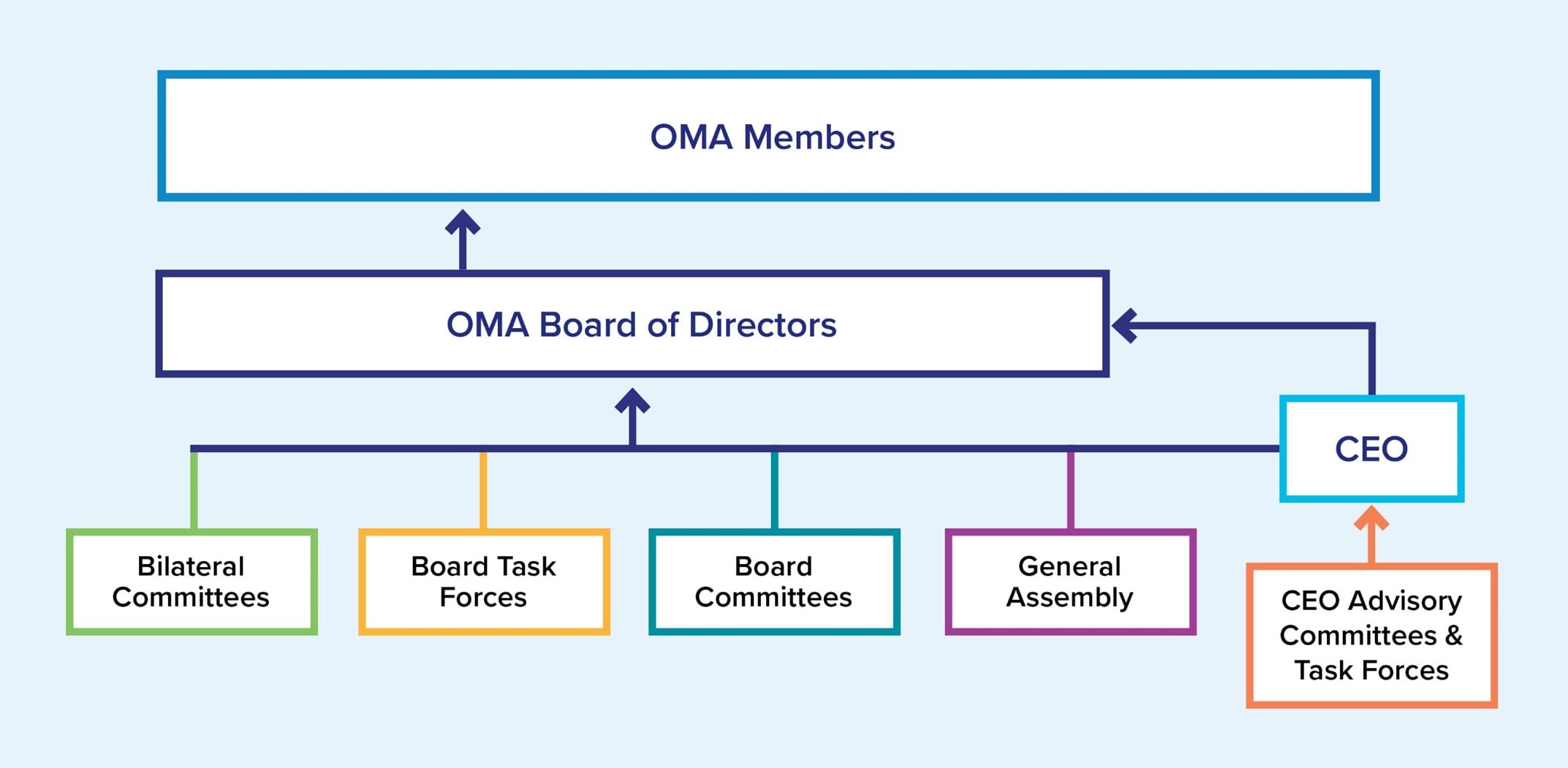
info@oma.orgCommittees are a key part of the organization’s governance structure, supporting oversight, decision-making, and the advancement of strategic priorities. They have delegated authority from the board to perform work on complex or specialized issues and bring forward recommendations for action to the board, which retains collective decision-making authority.
The OMA has different types of committees, including standing board committees, as well as bilateral and advisory committees and task forces.
Roles on committees aren’t just about contributing to governance – they’re about lending expertise, lived experience, and perspective to issues that matter deeply to physicians and the health system more broadly.
Recruitment for advisory and bilateral committees typically takes place twice a year, in the spring and fall. Recruitment also takes place on an ad hoc basis for time-limited working groups or other initiatives, depending on emerging priorities and organizational need.
The OMA has implemented a revised Appointment Policy and Procedure. Building on that foundation — and as part of our ongoing committee modernization work — we continue to strengthen onboarding for new members, expand learning and development opportunities, and introduce evaluation mechanisms to support continuous improvement. These efforts are designed to ensure every committee is well-supported and positioned to deliver meaningful impact.
Recruitment status update
Thank you for your interest in the Physician Services Committee (PSC) and Physician Health Program Advisory Panel (PHP) recruitment process. We are pleased to share that we received 21 applications for PSC and 21 applications for PHP.
Next Steps:
- Applications will be reviewed by OMA staff and evaluated by the Governance and Nominating Committee (GNC).
- Shortlisted PSC candidates will be invited to participate in a 25-minute interview with the GNC (late August to Early September)
- Appointment recommendations will be presented to the OMA Board of Directors at its September meeting for consideration.
- All candidates will receive written notification of the outcome of their application.
Thank you to all members who took the time to apply and support OMA governance through this recruitment process.
How the committees work
Key accomplishments
Throughout 2024, OMA committees contributed meaningfully to advancing the organization’s strategic priorities - from the hard work at the bargaining table by the Negotiations Task Force that led to a historic arbitration award, to the Physician Payment Committee’s oversight of the proposal intake process supporting fee modernization.
The Joint Forms Committee introduced new tools to reduce administrative burden, while the Relativity Advisory Committee, PPC and other groups continued to work to address gender pay gap and advance fairness in physician compensation.
Board committees
There are three standing committees of the OMA Board of Directors, including the Finance and Audit Committee, the Governance and Nominating Committee and the Human Resources and Compensation Committee. A comprehensive review of their mandates and charters was recently completed. The board approved revised charters in December 2023.
Except for the board chair, who is an ex-officio voting member of all board committees, board directors and observers serve on one board committee.
Finance and Audit Committee charter 
The Finance and Audit Committee (FAC) assists the board of directors in monitoring and oversight of the financial affairs of the association, its subsidiaries, and the OMA employees’ pension plans. It also ensures compliance with all applicable laws and regulatory requirements relating to financial reporting and disclosures. Areas of oversight include:
- Financial planning, reporting and internal control
- Operating plan
- External audit
- Compliance and risk management
- Internal audit
2025 highlights
- 2025 fiscal audit by Deloitte LLP
- Oversight of MNP’s comprehensive audit of the OMA’s constituency group funding as part of the association’s regular audit plan
- Oversight and input into the development of the OMA’s 2025 operating and capital budget
- Oversight of the OMA’s Risk Management
- Collaboration in the development of the new OMA Leader Compensation Policy
Members
- David Collie, chair
- Dr. Ramsey Hijazi, vice-chair
- Sue Armstrong, CPA, non-OMA director
- Dr. Sharon Bal, OMA board chair
- Dr. Hemant Shah
- Dr. Zainab Abdurrahman (non-voting observer)
Governance and Nominating Committee charter
The Governance and Nominating Committee plays a key role in providing the board the assurance that the OMA’s structures, policies and processes support the board in fulfilling its fiduciary and other duties effectively. The GNC has five voting members, including the chair of the General Assembly Steering Committee and an OMA member-at-large. The president-elect sits on the committee as an observer.
2024 highlights
- Successful recruitment and appointment to advisory committees, OMA subsidiary boards, PSA bilateral committees such as the Physician Payment Committee (PPC), the PHP Advisory Panel, while also ensuring adequate OMA representation on external bodies
- Revised OMA Board Committee Appointment Policy to better align with governance best practices, including a more open and transparent process with a stronger focus on skills and experience.
- Reviewed and proposed amendments to OMA bylaws and articles of incorporation to comply with Ontario’s Not-for-profit Corporations Act (ONCA). The proposed amendments were approved by the membership at OMA’s Annual General Meeting in May 2024.
- Provided feedback and input into ongoing efforts to enhance physician leadership development and other initiatives to improve governance capacity and leverage physician leaders’ expertise within the OMA and broader health system. A series of online training modules have been developed to support physicians in their leadership roles. Topics include OMA Policies, OMA Governance, Health System 101, Leading Effective Meetings, among others.
- Provided oversight and input into ongoing constituency governance review. Initial phases focusing on the districts and sections are now complete, with updated charters in place for all groups. The current phase of this work includes the OMA’s fora and medical interest groups (MIGs).
Members
- Dr. Cathy Faulds, chair
- Dr. Alykhan Abdulla, GASC chair, ex-officio
- Dr. Sharon Bal, OMA board chair
- Dr. Katherine McKay, member-at-large
- Dr. Brian Rotenberg
- Dr. Haroon Yousef, president-elect, non-voting observer
HR and Compensation Committee charter
The Human Resources and Compensation Committee is mandated to assist the Board of Directors in its oversight duties with respect to the selection, development, evaluation, compensation and succession planning of the CEO and oversight of the OMA’s key talent management and human resources philosophy, strategies, practices and programs.
The HRCC provides assurance to the board that effective policies and practices exist within the OMA to attract and retain the people required by the OMA to meet the strategic plan. The committee also enables and ensures that appropriate HR support exists for the CEO to provide for a productive culture within the organization. The committee has five members.
2025 highlights
- In 2025, the Committee worked with CEO, Kim Moran, to set realistic and achievable goals directly tied to the OMA's Strategic Operating Plan that were measurable and showed value to Membership and Board
- The Committee and CEO are collectively focused on continual improvement, working to refine and modernize processes
Members
- Jennifer Quaglietta, chair
- Dr. Khalid Azzam, vice-chair
- Dr. Kenneth Fung
- Dr. Rebecca Hicks, president
- Dr. Sharon Bal, OMA board chair
Nominations and Appointments Committee charter
The Nominations and Appointments Committee (NAC) has a dual reporting relationship with the Governance and Nominating Committee (GNC) and the General Assembly Steering Committee (GASC). The committee is comprised of five voting members and the immediate past president as an ex-officio, non-voting member.
The NAC is responsible for the oversight of the recruitment and appointment of qualified members to serve on the panels and working groups of the General Assembly. The committee also supports the promotion and recruitment of qualified candidates for election to the GASC and the Board of Directors.
2025 highlights
- Approved 2025 appointment recommendations for the Advocacy, Communications and Engagement (ACE) Panel, Health Policy Panel, and Compensation Panel
- Recommended the establishment of a time-limited working group to advance priorities regarding the functionality and usability of out-of-hospital certified EMRs
- Provided input and contributed feedback on key governance initiatives including enhancements to the OMA Appointment Policy and Procedures, the OMA board officer role review, OMA committee recruitment process, and the OMA committee modernization work
Members
- Dr. Justin Hall, chair
- Dr. Diana Kljenak, vice-chair
- Dr. Levi Burns
- Dr. Sara Colozza
- Dr. Tristan Snider
- Dr. Zainab Abdurrahman, past president, non-voting observer
Negotiations Task Force charter
The Negotiations Task Force (NTF) is a board task force that works bilaterally to negotiate the Physician Services Agreement with the Ministry of Health’s negotiating team. Terms of service on the NTF are mandate driven. The current NTF was appointed in February 2023 and is comprised of five members: two specialists and two general/family practitioners. The physician members of the NTF are supported by two external negotiations advisers.
2025 highlights
In early 2025, the NTF sought to build on the success of the September 2024 Year 1 arbitration award by pursuing agreement via negotiations and mediation on matters related to the general normative increases for Years 2-4, and outstanding matters related to targeted physician compensation initiatives.
In Spring 2025, the NTF and Ministry of Health reached bilateral agreement in three key areas ahead of arbitration: emergency medicine, rural and northern Ontario, and an updated Pregnancy & Parental Leave Benefit Program.
Arbitration took place in July 2025 on outstanding matters, and the Board of Arbitration released their award in September 2025. The award included an overall general normative increase of 7.3 per cent (7.5 per cent compounded) for Years 2-4. In addition, a further 2.2 per cent in targeted compensation was announced through the award and further bilateral agreements; yielding a total increase of 9.5% over Years 2-4.
Furthermore, the NTF sought clarity on timelines and dispute-resolution pathways relating to payment accuracy and implementation during an expedited hearing in November 2025. Resulting from this, the arbitration board determined that the Ministry should issue one retroactive payment no later than November 1, 2026.
In November 2025, OMA communicated to members that the NTF and Ministry reached agreement on the relativity split for the general increase for Years 2-4. The Parties agreed that 75% of the increases would be specialty-specific and determined using updated CANDI/RAANI scores, and 25% would be applied equally across-the-board. This approach is the same as the Year 1 split.
Members
- Dr. Atul Kapur, emergency medicine, chair
- Dr. Nikolina Mizdrak, family medicine, vice-chair
- Dr. Patrick Conlon, psychiatry
- Dr. David Neilipovitz, anesthesiology
- Dr. Winnie Wong, family medicine
Bilateral committees
Bilateral committees include core membership from the OMA and Ontario Ministry of Health, respectively. The OMA side of these committees is appointed by, and accountable to, the OMA Board of Directors.
Bilateral MOH-OMA Education and Prevention Committee Terms of Reference
The Education and Prevention Committee operates as a standing committee reporting to the Physician Services Committee and the OMA Board of Directors. The EPC includes four OMA members and works bilaterally to improve physician awareness and understanding of appropriate OHIP billing by developing and communicating education resources.
2025 highlights
The bilateral EPC continues to develop educational resources (Billing Briefs) pertaining to select areas of the Schedule of Benefits. Since 2022, the EPC has developed and published a series of Billing Briefs to support physicians across specialties. In 2025, six additional briefs were released, providing high-level guidance on key OHIP billing topics, including available resources, appropriate use of specific fee codes (e.g., K133, Z363, E550), strabismus procedure-specific considerations, and claim submission requirements such as timelines and stale-dated claims.
The briefs can be found here.
Members
- Dr. Artur Gevorgyan, otolaryngology
- Dr. Prateek Sehgal, critical care medicine
- Dr. Jane Healey, pediatrics
- Dr. Winnie Wong, family practice, chair
In accordance with the 2021 Physician Services Agreement, the Physician Payment Committee was struck to replace the Medical Services Payment Committee. Its mandate is to make recommendations on how to implement each constituency’s compensation increases to the Schedule of Benefits. The PPC operates as a standing bilateral OMA-Ministry of Health committee reporting to the PSC and OMA Board of Directors and includes four OMA members, appointed for a two-year term, and one observer.
2025 highlights
Following the announcement of the historic award for Year 1 (2024-2028 PSA), the PPC invited OMA constituencies to submit additional fee proposals for consideration as part of the current fee-setting process. In 2025, the committee received 362 new submissions from 46 OMA constituencies, containing 1,181 proposed fee changes. This adds to the 651 proposed changes already under consideration of the PPC as part of the Year 3 (2021-2024 PSA) proposal intake process. In total, there were 1,832 proposals under review by the committee under the year 3 & 1 process.
PPC finalized its recommendations for year 3 (2021-2024 PSA) & year 1 (2024-2028 PSA) and delivered them to PSC and OMA Board; MOH brought the recommendations to Cabinet office. The recommendations were approved and implemented by MOH in 2026.
As of April 1, 2026, the increases prescribed in the PSA were permanently implemented into the OHIP schedule of benefits. Over 3000 changes were made to the schedule of benefits as a result of this, most recent, fee setting process. Flow through payments were also applied to non-fee-for service contracts.
Following receipt of details on implementation of Years 2-4 (2024-2028 PSA) from the NTF, the PPC launched a new fee setting process to implement permanent schedule of benefits changes again, with a target date of April 1, 2027.
This new process which will result in Schedule of Benefits changes beginning April 1, 2027, involves developing fee proposals to modernize the fee schedule, address issues related to fee relativity and gender pay equity in medicine, and incorporate changes to medical innovation and/or technological advancements. OMA sections, medical interest groups and fora are tasked with consulting with their members in developing these proposals.
The PPC has:
- Completed its final recommendations for Years 1 (2021-24 PSA) & Year 3 (2024-28 PSA) and has delivered recommendations to PSC and OMA Board
- PPC Launched a new fee setting process for Years 2-4 (2024-28 PSA)
- Hosted constituency presentations (bilateral):
- Met with 44 constituencies in March/ April 2025
- Met with 36 constituencies in February/March 2026
- Ad hoc meetings have also taken place with constituency leaders on an ad hoc basis by the OMA-side, as well as bilaterally
The OMA side of the PPC has also:
- Participated in monthly physician leader update calls
- Met with the surgical and medical networks
- Provided an update to members as part of OMA Live webinar
- Provided status updates through OMA News
- Developed new resources in support of the Year 2-4 fee setting process, including:
- Hosted an information session for constituency leaders to launch the Year 2-4 process (2024-2028 PSA)
- Developing and launching a new video course all about the PPC and the Fee setting process in Ontario. This resource is available on OMA learns
- Met with consistency leaders on an ad hoc basis throughout 2025 (both on the OMA side and bilateral)
Learn more about the Physician Payment Committee (member-only).
Members
- Dr. Dan Reilly, obstetrics and gynecology, OMA co-chair
- Dr. Neshmi Zaman, family practice
- Dr. Marilyn Crabtree, family practice
- Dr. Peter Lovrics, general surgery
- Dr. Meherzad Kutky, nephrology (observer)
MOH Members:
- Dr. Michael Klar, family practice (Toronto), MOH co-chair
- Dr. Moira Browne, family practice (Kingston)
- Dr. Lindsay Davidson, orthopedic surgery (Kingston)
- Dr. Michael de la Roche, emergency medicine (Belleville)
2025 highlights
In 2025, the PSC played a central role in advancing the implementation of the 2024— 2028 Physician Services Agreement (PSA) while supporting broader health system priorities.
The year marked a transition from agreement to execution. PSC focused on operationalizing PSA commitments, contributing to system transformation discussions, addressing physician workforce challenges, and serving as a structured forum to resolve complex bilateral issues. Across these areas, PSC reinforced its role as both an implementation body and an important table to reach alignment between the OMA and the ministry.
PSA implementation
Building on legacy commitments from the previous PSA, PSC also advanced new commitments under the 2024 agreement, including the new FHO+ model, development of new alternate payment plans (APPs) and targeted funding initiatives. This approach required careful coordination, as work continued to complete outstanding deliverables while simultaneously launching new priority initiatives.
PSC maintained oversight of multiple implementation streams, including several APP working groups, supporting extensions where necessary to ensure the integrity of the work while maintaining momentum. At the same time, PSC enabled escalation pathways where agreement could not be reached, including referral of complex issues to arbitration.
PSC supported the implementation of several key PSA initiatives including compensation increases for pediatric hospital-based services, such as those at SickKids and CHAMO, as well as several Emergency Department stabilization measures including 24-hour site shadow billing, premiums for increased patient visits, and the Regional Emergency Medicine Call Funding (REMCIF) program. PSC also advanced implementation of the in-hospital anesthesia stipend, aimed at improving access to surgical and procedural care.
PSC supported enhancements to rural and northern physician recruitment and retention programs through updates to the Rural and Northern Physician Group Agreement (RNPGA). This included expanded locum support, with additional days available per vacancy, and harmonization of locum rates with HealthForceOntario programs. PSC also advanced increased overhead funding for physician groups, as well as targeted investments in emergency and on-call services, including increased base funding for 24-hour Emergency Departments and enhanced on-call funding for communities without an ED.
Additional progress was made on targeted funding and program enhancements, including initiatives such as pregnancy and parental leave benefit program and physician health benefit program.
In primary care, PSC supported advancements related to FHO+, including updates to the boilerplate agreement, refinements to the managed entry process, and the development of co-location guidelines to support team-based care models. PSC also supported the bilateral implementation of the continuity of care measure and the hourly rate payment, as well as the implementation of the enhanced group leadership and management payment, contributing to improved alignment of compensation and physician leadership within primary care models.
For an update on PSA Implementation activity, visit our dashboard.
Primary care policy
Primary care remained a central focus of PSC’s work in 2025, reflecting its critical role within the health system.
PSC supported discussions with the Primary Care Action Team (PCAT) on the government’s objective of connecting all Ontarians to primary care, while reinforcing the need for expanded physician capacity and team-based care models. To support ongoing alignment, PSC facilitated the establishment of a dedicated sub-table between PCAT and OMA leadership.
PSC also elevated operational and policy challenges impacting primary care physicians, including issues related to funding models, administrative burden, and program design. These discussions helped ensure that physician perspectives were reflected in ongoing policy development.
In parallel, PSC supported the exploration of new models of care designed to optimize interdisciplinary teams while maintaining physician leadership. This work contributed to shaping a more sustainable and accessible primary care system.
Health system transformation and role of the physician
PSC played an important role in shaping broader health system transformation discussions, with a consistent focus on ensuring that physicians remain central within evolving models of care.
PSC provided input on broader transformation initiatives, including proposals related to scope-of-practice expansion for non-physician providers. In these discussions, PSC emphasized patient safety, quality of care, and the importance of physician-led models.
In addition, PSC contributed to system modernization efforts, including digital health initiatives such as eReferral and central intake. Across these discussions, PSC consistently advocated for early and meaningful physician engagement in design and implementation.
Health human resources planning
Addressing physician workforce challenges remained a key priority for PSC in 2025.
PSC advanced work on rural and northern workforce strategies, including early implementation planning for targeted PSA investments aimed at improving recruitment and retention. This work was complemented by broader discussions on the need to better align existing programs and reduce fragmentation across the system.
PSC also supported the development of more coordinated approaches to workforce planning, including early work toward a Rural Coordinating Network model. Planning for a Northern Physician Summit represented an important step in bringing together system partners to inform a more integrated, system-level approach to workforce challenges.
Dispute resolution and issue management
Throughout the year, PSC addressed a range of complex bilateral issues, including disagreements related to APP design and pricing. Where necessary, PSC facilitated escalation to formal dispute resolution mechanisms, including arbitration.
PSC also played an important role in elevating systemic operational challenges affecting physicians, including OHIP payment delays, rejected billings, and administrative burden. These discussions resulted in increased ministry awareness and commitment to addressing these issues.
Conclusion
In 2025, PSC demonstrated its value as both an implementation body and a strategic forum for alignment between the OMA and the ministry. The Committee advanced key PSA commitments, contributed to system transformation discussions, and addressed complex operational and policy challenges facing physicians.
Looking ahead to 2026, PSC will continue to focus on delivering key implementation milestones, advancing transformation initiatives, and strengthening coordinated approaches to workforce planning, while maintaining its central role in resolving issues and supporting system alignment.
Members
OMA
- Dr. Nikolina Mizdrak, chair, general and family practice
- Dr. David Schieck, vice-chair, general and family practice
- Dr. Sonal Gandhi, medical oncology
- Dr. Ramsey Hijazi
- Dr. Haroon Yousuf, president elect
MOH
- Dr. Calvin Law, surgical oncology
- Dr. Nadiya Sunderji, psychiatry
- Dr. Sarah Jarmain, psychiatry
- Dr. Sayali Tadwalkar, rural family practice
Advisory committees, task forces and panels
OMA advisory committees and task forces report to the CEO and board. Committees are physician-led, with support from OMA staff. A governance review is currently underway for all advisory committees to ensure the mandates and composition of these groups are in alignment with organizational needs and priorities, as well as governance transformation changes.
Advocacy, communications and engagement panel charter
2025 highlights
In 2025, the Advocacy, Communications and Engagement (ACE) Panel strengthened alignment across advocacy, member engagement, and communications, while advancing several high-impact member-driven priorities.
A key milestone was the integration of multiple committees into the ACE Panel, bringing together member relations, advocacy and communications, and member services. This created a more coordinated and strategic approach to engaging members and advancing advocacy priorities.
The Panel successfully completed two major General Assembly priorities:
- Reducing Delays in Patient Care, including the development of a targeted advocacy plan for palliative care and a practical Advocacy Toolkit to support grassroots physician advocacy
- Data Supports for Health Human Resources (HHR), improving the use of data to inform workforce planning and decision-making
A third priority is well underway, with over 600 members engaged to address:
- Improving out-of-hospital certified electronic medical records (EMRs), by collaborating with OntarioMD to better understand member needs and identify opportunities to reduce administrative burden.
In addition, the ACE Panel advised on multiple advocacy campaigns and member-facing initiatives and service offerings, ensuring alignment with member priorities and strengthening the impact of OMA’s advocacy and engagement efforts.
Looking ahead
In 2026, the Panel will focus on:
- Completing the EMR priority, translating member insights into clear recommendations
- Advancing the priority to increase access to physician-led multidisciplinary care, supporting team-based models that improve access and patient outcomes
- Continuing to align advocacy, communications, and member engagement efforts to better support members and drive system change
ACE panel members:
- Dr. Douglas Bell
- Dr. Karen Devon
- Dr. Julie Kovacs
- Dr. Pamela Liao
- Dr. Hamidah Meghani
- Dr. Vincent So
- Dr. Dannica Switzer
- Dr. Rebecca Hicks, OMA president
The Awards and Recognition Committee (ARC) identifies and recommends suitable recipients of various OMA, CMA and other select organizations’ awards as directed by the OMA Board of Directors and/or CEO.
2025 highlights
- Issued 2024 and select 2025 OMA awards
- Completed the full rollout of the modernized OMA Awards program, including the introduction of year-round nomination submissions to support increased participation
- Development of an informal recognition program
- Increased awareness of the OMA awards program through collaboration with system partners, including the Professional Association of Residents of Ontario (PARO) and the Ontario Medical Student Association (OMSA)
Members
- Dr. Zainab Abdurrahman, chair, OMA immediate past president
- Dr. Sharon Bal, OMA board chair
- Dr. Alykhan Abdulla, GASC representative
- Dr. Philip Baer
- Dr. Vincent Chan
- Dr. Laura-Eve Mantella
The mandate of the Task Force is to develop a baseline (benchmark) and make recommendations on system-level solutions to reduce burnout among physicians, residents and medical students in Ontario and contribute to the achievement of the Quadruple Aim for health care system effectiveness by improving providers’ work lives.
2023 highlights
The bilateral MOH-OMA Burnout Task Force meets regularly, with a priority focus on administrative burden. It was successful in obtaining the support of the Ministry of Red Tape Reduction to reduce administrative burden through forms, beginning with forms prioritized by the physician members of the Joint OMA-MOH Forms Committee and the OMA Forms Committee. The forms committees identified the first priority forms based on consultations and surveys, members’ proactive communication on forms issues, guiding principles for best practices, and their expertise on forms.
This work is being led on the government side by the MOH and the Ministry of Red Tape Reduction, with involvement from the Cabinet Office and various form-owner ministries, and with oversight from the Premier’s Office.
The Task Force developed a guide on the standard measure of burnout identified by the group to help system stakeholders utilize the measure. The MOH as agreed to co-brand that guide and will be working with the OMA on publishing and disseminating it to health system stakeholders.
Also in fall 2023, the Task Force convened the Canadian Life & Health Insurance Association (CLHIA), Manulife, and the Forms Committee to discuss opportunities to reduce burden through insurance forms. The Ontario College of Family Physicians also joined, as they have been pushing the issue forward. CLHIA shared work it has begun, including a simplified standard short-term disability form for Canada, and the Task Force encouraged the association to include physician review as they develop standard forms. The Task Force also discussed the importance of insurance companies removing the requirement for physician referrals to paramedical services.
A new topic being explored by the Task Force is centralized referral. This followed work on wait times and recommendations made on centralized referral in the February 2022 Integrated Ambulatory Centre white paper.
The Burnout Task Force will explore the issue given the element of burden involved in referrals. Centralized referral will be discussed at the next meeting.
Members
- Dr. Mamta Gautam, chair
- Dr. Stephanie Klei
- Dr. Simron Singh
- Dr. Chris Bourdon
- Dr. Carol-Anne Moulton
Civility, Diversity and Inclusion charter
The Civility, Diversity and Inclusion Committee was struck to create a culture of civility at the OMA and empower members to promote and participate in civility. Its responsibilities included the adjudication of disputes between members, and engagement in activities and exercises to promote diversity and inclusion, such as the development of educational tools and resources.
In 2023, the CDI developed a Code of Conduct & Civility for all OMA members involved in OMA work, which was approved by the Board of Directors in 2024. Based on experiences of the committee in dealing with physician civility complaints, the work around complaints and civility was rolled into the organizational Respect in the Workplace Policy and its associated processes, and is no longer under the purview of the committee.
The committee is currently engaged in a governance review to determine how to best be organized to deliver on the civility and equity, diversity and inclusion components of its charter. Given that complaints are no longer the responsibility of the committee, it is likely that the mandate of the committee will shift to an EDI focus in future.
Members
- Dr. Alison Freeland, chair
- Dr. Tisha Joy, vice-chair
- Dr. Clover Hemans
- Dr. Sung Min Cho
- Dr. Anthea Paul
General Assembly Panels Charter
2025 highlights
In 2025, the Compensation Panel focused on supporting broader engagement with members through the General Assembly (GA).
A key area of focus was aligning the Panel’s work with the Physician Payment Committee (PPC). The panel supported a more targeted approach to 2026 prioritization, including pausing new idea intake to focus on advancing existing priorities and ensuring meaningful progress.
In addition to its advisory work, the Panel played an active role in member engagement at the Fall 2025 General Assembly meeting by:
- Supporting and shaping the PPC process improvement session
- Facilitating breakout discussions with members
- Providing real-time feedback on engagement design, ensuring discussions remained focused, strategic, and solutions-oriented
Through this work, the Panel contributed to more structured, informed dialogue with members and strengthened alignment between compensation priorities and broader OMA initiatives.
Looking Ahead
In 2026, the Compensation Panel will focus on deepening its work and translating discussions into more concrete outputs.
Key areas of focus include:
- Continued support with exploring improvements on PPC implementation
- Advancing priority work on time-based billing and alternative compensation models
- Expanding the panel’s role as a sounding board
- Continuously evolving to align with governance modernization
Compensation panel members:
- Dr. Robert Dinniwell
- Dr. Kathleen Gregory
- Dr. Eric Goldszmidt
- Dr. Jane Healey
- Dr. Mark Kaluzienski
- Dr. David Schieck
- Dr. Laura Targownik
The Health Policy Panel is a group of expert physicians with deep knowledge of health system policy, that provides strategic insight and leadership on complex and evolving policy issues. The Panel informs and influences health system policy by bringing forward physician perspectives on member driven and emerging issues, and by supporting the development and alignment of PLG Health Policy priorities.
As its work progresses, the Panel will play a central role in shaping a future facing health policy agenda by providing expert advice on priority areas affecting physicians and the health system. This will include policy issues related to family medicine, the role of community based specialists, central intake and referral models, reducing administrative burden, and optimizing team based care. Through forward looking analysis and policy dialogue, the Panel will help identify emerging trends, challenges, and opportunities, strengthening proactive policy development and positioning the organization to respond effectively to system change.
Health policy panel members:
- Dr. Travis Carpenter, chair
- Dr. Madeline Verhovsek, vice-chair
- Dr. Dharmendra Doobay
- Dr. Michael Finkelstein
- Dr. Camille Lemieux
- Dr. Charlotte Moore
- Dr. Jane Purvis
Relativity Advisory Committee charter
The OMA Relativity Advisory Committee (RAC) is responsible for the development of the Fee-Adjusted Income Relativity (FAIR) model. The group’s work on FAIR has been postponed pending the outcome of both negotiations and schedule of benefits modernization.
2025 highlights
In 2025, the group was responsible for adding the Palliative Medicine Group into existing relativity calculations under the OMA’s Comparison of Adjusted Net Daily Income (CANDI) model.
Members
- Dr. Eric Goldszmidt, anesthesiology (surgical)
- Dr. Sonu Gaind, psychiatry (medical network)
- Dr. Marilyn Crabtree, family practice (primary care)
- Dr. Jerome Fan, emergency medicine (medical)
- Dr. Ipshita Kak, pathology (diagnostic)
- Dr. Nicholaus Bauman (surgical)
- Dr. Caitlin Ward, diagnostic imaging (diagnostic)
The OMA Forms Committee and the Bilateral Joint Forms Committee reports to the Physician Services Committee (PSC) and the OMA Board of Directors. Membership consists of four OMA members and OMD representatives, and there is equal representation from the MOH for the bilateral committee, which meets six times a year.
The committee is dedicated to reviewing all new, revised, or existing forms that need to be completed by physicians, including the need for any changes to existing forms, including digitization and the use of new technologies. When appropriate committee develops recommendations for physician remuneration. To help provide guidance toward the objective assessment of any current or proposed new form, the committee has developed guidelines on best practices for the review of forms. The main principles are digital first, patient attestation, appropriateness, and remuneration.
The committee responds to all member form or form process queries that are brought forward. Examples of such queries are ODSP Home Equipment, MOHLTC Nutrition Products, Service Canada, ADP Orthotic Devices, RAC-PBP, Medical Certificate for Employment Insurance Family Caregiver Benefits, Return to Work forms, ADP Hearing Aid funding form, Pharmacy Requests, HPV form, Municipal Accessible transit and the Bariatric Network referral form.
2025 highlights
The OMA Forms Committee met six times in 2025 not including any other special meetings. Key issues addressed and ongoing activities of the committee include:
- Participation in the CMA Return to Work Policy review working group
- Participation in the Ontario Health FIT requisition working group
- Collaboration with Ontario Works & ODSP in streamlining & simplifying the MCCSS, MSN benefit application & Limitations to Participation form
- Ministry of Transportation Cardiovascular Assessment form and Mandatory Report Form reviews
- MOH Health Assessment Form for Eligibility for Long-Term Care Home form review
- Participation in the Ontario eServices Program Best Practices working group, Patient before Paperwork (Pb4P) working group, Ontario Perinatal Record Refresh Committee and the Diagnostic Imaging working group
- MOH Request for a Major Eye Examination form review
- Ministry of Health Assistive Devices Program Application for Funding Hearing Devices form
- Service Canada, Certificate of Incapability form
- Insurance portals and PHIPA privacy standards
- CMA/CRA/OMA meetings re: Disability Tax Credit form
- MOH Office of the Chief Medical Officer of Health working group regarding the optimization of a new standardized Health Assessment form related to the Tuberculosis Medical Surveillance (TBMS) process.
- A Prescription for Nature (PaRx), federal nature prescription program
- EDR (electronic death registry) form process
Looking ahead
Continue to make every reasonable effort to reduce the amount of administrative work performed by physicians to increase patient access to care and continued participation with internal and external working groups.
Members
- Dr. Scott Elliott, chair
- Dr. Marilyn Crabtree
- Dr. Debra Dyke
- Dr. Jane Purvis
Physician Human Resources Committee charter
The OMA Physician Human Resources Committee (OHRC) reviews research and evidence on existing and emerging physician human resources issues to provide recommendations to the OMA Board and CEO that support decision-making, policy formulation, workforce planning, and negotiations. OHRC members are the OMA’s representatives on the bilateral Physician Human Resources Working Group (PHRWG), a subcommittee of the Physician Services Committee, which is the collaborative process for identifying and responding to urgent physician workforce issues in the province.
2025 highlights
In 2025, the OHRC identified physician workforce and health system priorities, and focused on leading practices in planning and innovative approaches to solutions, for example, enhanced skills training and succession planning as workforce interventions, and examination of successful models in other jurisdictions.
Achievements at the bilateral table include undertaking a fulsome review of Underserviced Area Programs, advising on the development of a Rural Coordinating Network for Northern Ontario, and planning a co-design Summit of northern physicians, government, and system stakeholders held in March 2026. The OHRC also provided advice on physician distribution incentive programs and proposed eligibility changes; recommended improvements to the Practice Ready Ontario assessment program; and secured enhancements to the Clerkship Travel Program to expand access to northern learning experiences.
The committee’s expertise informed the OMA’s We Won’t Give Up campaign on the priorities of northern and rural health, access to family physicians and specialists, and supporting and sustaining physician wellness.
The committee provided commentary to the Auditor General of Ontario’s audits on the education of family medicine physicians and the recent expansion of medical school seats, and the availability of primary care practitioners across the province.
The OHRC also contributed to the CMA’s Integrated Health Human Resources Planning Policy, emphasizing the Ontario context, and sharing OMA-developed tools and frameworks.
Key priorities over the coming year include:
- Supporting the Negotiations Task Force in arbitration proceedings on issues related to implementation of the Physician Services Agreement and Arbitration Award
- Advising the bilateral PHRWG on urgent physician workforce issues, emphasizing that solutions must focus on the “3-Rs”: Retention of the current workforce, Recruitment to the Ontario physician workforce, and Return of physician capacity to the workforce
- Providing government with the physician perspective on medical education expansion, pathways for internationally educated physicians and learners, and the opportunities and unintended consequences associated with these initiatives
- Informing the development of the Physician Resources Integrated Model (PRIME) for physician workforce planning. PRIME is an OMA innovation project that is being constructed in phases and, once complete, will inform policies to align health workforce capacity with population health needs under different scenarios
Members
- Dr. Sarah Simkin, co-chair
- Dr. Robert Dinniwell, co-chair
- Dr. Sarah-Lynn Newbery
- Dr. Carmine Simone
Physician Health Program Advisory Panel terms of reference
The panel serves to provide strategic advice and support for the PHP, fostering collaboration between the OMA and relevant partners while enhancing program objectives and awareness.
2025 highlights
- New panel members focused on building their understanding of PHP’s mandate and impact and began their role as active advisors and champions.
- The panel informed the PHPs approach to outreach and engagement with members and supported the promotion of key activities including the 2025 PHP Conference and the Physicians Stories video series as opportunities to build awareness and reduce stigma.
Members
- Dr. Janel Gracey (addiction medicine), chair
- Peter Farvolden (allied health)
- Dr. Sanch Gupta (medical learner)
- Dr. Rebecca Hicks, OMA Board observer
- Dr. Jessica Hopkins (public health)
- Dr. George Photopoulos (family practice)
- Dr. Ushma Purohit (medical learner)
- Dr. Tara Riddell (psychiatry)
- Dr. Devon Shewfelt (family practice)
- Dr. Carlos Yu (family practice, psychotherapy)
Uninsured Services Committee charter
The Uninsured Services Committee (USC) is mandated to review and recommend revisions to the Physician’s Guide to Uninsured Services and Schedule of Fees as required, and to recommend fees for new or unlisted uninsured services. The committee comprises four members, and work is completed on an annual cycle.
2025 highlights
- In consultation with the various OMA sections, MIGs and fora, the committee made several updates to the Physician’s Guide to Uninsured Services
- In terms of OMA fees, the fees in the guide were increased by 2.20 per cent and the OMA multiplier, which is used to calculate the OMA fee for uninsured services, increased from 2.88 to 2.90
- Created new sections in the guide such as the UHIP/CIHIP, billing for federal public safety and service institutions and LTC medical director suggested compensation model
- Published an OMR digital article highlighting challenges with uninsured billing and reinforcing OMA’s support and assistance for members
Members
- Dr. Lisa Fu
- Dr. John Harrington
- Dr. Rosemary Hanna
- Dr. Scott Whynot