


Dive into some of the most-asked questions about this digital technology
You’ve no doubt heard how AI scribes are helping decrease administrative burden and improve clinicians’ well-being.
But what is AI scribe technology? How could it be useful to you? If you haven’t made the switch in your clinic, we answer some of your biggest questions to help you stay informed.
 What are AI scribes, and how can I use them in my practice?
 These digital tools use artificial intelligence to listen to clinical encounters and generate electronic, clinically relevant medical notes. Some can also automate routine time-consuming tasks, such as generating referral letters, pulling up a patient’s chart, setting reminders for followups and medication refills, and more.
An AI scribe typically has a monthly or annual licensing fee, although the amount ranges based on your agreement, the tool you choose and its functionality.
AI scribes show promise in reducing administrative burden, cognitive fatigue and after-hours charting.
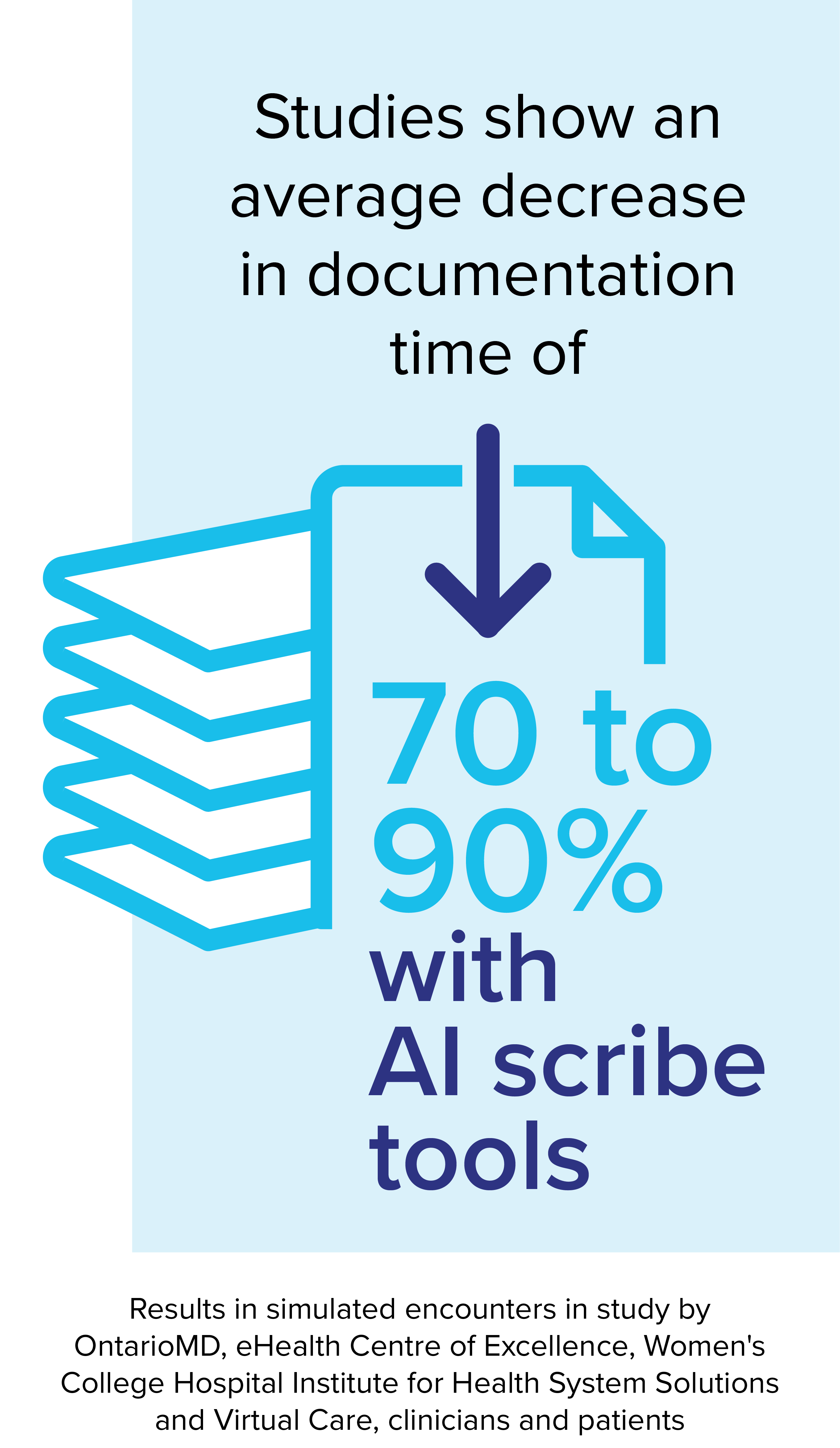
Family doctors reported spending between 70 to 90 per cent less time on paperwork and saving three to four hours per week in a 2024 OntarioMD evaluation study of AI scribes.
And those efficiency gains are starting to appear in clinical practice. In the Canadian Medical Association’s most recent National Physician Health Survey, 59 per cent of doctors reported that AI has already decreased the time they spend on administration.
If you’re considering an AI scribe, remove the guesswork and gain confidence and support by checking out the Ontario AI Scribe Program. It offers a list of AI scribe vendors that meet Ontario’s privacy and security standards, as well as complimentary professional guidance from OntarioMD on optimizing your scribe and managing the workflow integration.
While AI scribes can potentially save time, it’s important to understand they have limitations that can cause inaccuracies.
AI scribes can misinterpret information, produce errors in transcription and “hallucinate” by delivering confident, human-like yet fabricated responses. They can also introduce biases and encourage over-reliance on the technology by clinicians.
For these reasons, AI-generated notes and materials must always be reviewed and edited by a physician before being added to a patient’s record.
Using an AI scribe doesn’t change your obligations under Ontario law or professional standards. While scribes can support clinical practice, the accountability for patient privacy and the accuracy, completeness and confidentiality of medical records remains with the physician.
Physicians remain responsible for compliance with the Personal Health Information Protection Act. Also, CPSO policies on record keeping, confidentiality and professionalism continue to apply.
At a high level, this means:
Some AI scribe tools can move transcribed content into an EMR in a structured manner, but compatibility and functionality vary widely.
Make sure you review vendor details carefully and confirm EMR compatibility. Consult the Ontario AI Scribe Program’s Vendor Comparison Matrix to see which AI scribes work with different EMRs.
Check out our list of things to watch for to help you in your decision-making around AI, including vendor contracts. The Ontario AI Scribe Program has made it easy for you to choose an AI scribe. The program has vetted a list of qualified vendors and products and has done the contract legal due diligence for you. Visit the OntarioMD Practice Hub for more information, resources and tips and watch this video to learn more about why one Ontario psychiatrist chose an AI scribe.