

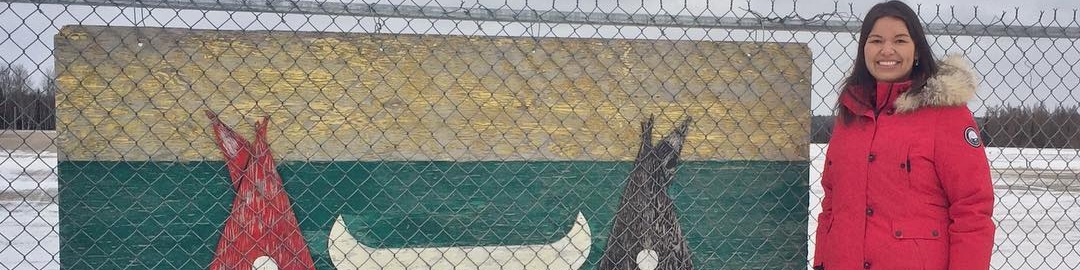
How a chance encounter led Indigenous physician Dr. Rebekah Neckoway to return north
Dr. Rebekah Neckoway pursued medicine for many reasons — to help people and to work in an evolving and intellectually engaging field.
Another motivation lay underneath: Growing up Indigenous in Thunder Bay, she’d never seen physicians who looked like her.
“In a way, it was my first stand against racism, because you feel so disempowered by it when you’re young,” she says. “I just grew up not being very outspoken.”
“In a way, it was my first stand against racism, because you feel so disempowered by it when you’re young.”
But today, as a family physician who has worked in Indigenous health care for 11 years, she has found her voice — and is using it to make a real difference.
Initially, she planned to pursue obstetrics and gynecology in a large city. But an experience in her third year of medical school changed her perspective.
During a clerkship visit to Eabametoong First Nation, her mother’s home and a fly-in Ojibway community more than 350 kilometres northeast of Thunder Bay, Ont., Dr. Neckoway met a woman and her young son. The woman recognized her as her mother’s daughter and explained to the boy that Dr. Neckoway was becoming a doctor.
“That made such a profound impact on me because I realized I was becoming the person I wish I’d seen when I was his age,” Dr. Neckoway says, with tears in her eyes.
“I didn't want to be just one of the millions of faces in Toronto, I wanted to go and work in the communities where kids like him would see someone who looks like them.”
In addition to her work as a family physician in Thunder Bay, she also spends about one week a month as a locum in remote First Nations communities in Treaty 9 territory, which covers about two-thirds of northern Ontario.
“Anything more than that can be exhausting, because you're kind of ‘on’ 24/7,” she says.
Yet these work trips provide a deep sense of connection.
“Some community members embrace me as their own and call me granddaughter, even though we are not directly related,” she says. “They really bring joy to my work.”
She still travels north with the physician from her clerkship, a mentorship that has meant sharing the emotional weight of working in an inequitable health system.
“Sometimes it can get heavy. Like, the water was shut off today for 12 hours and we didn’t know when it was coming back on,” she says. “These are the things happening within the community that impact that person in front of you.”
“I didn't want to be just one of the millions of faces in Toronto, I wanted to go and work in the communities where kids like him would see someone who looks like them.”
Being an Indigenous physician can bring unique pressures, such as learning she was the first Indigenous person to enter the University of Toronto’s Master of Health Sciences in Health Administration program.
“It felt very much like, ‘Well, I have to do this perfectly, I have to represent all Indigenous students now,’” she says. “I just represent myself; I don’t represent all Indigenous people everywhere.”
She is grateful for the opportunities provided by her parents, who are residential school survivors.
“My dad has his PhD, my mom has her master’s in education. They showed me, through hard work, what we can achieve,” she says.
She delivered the keynote at the Indigenous Physicians Association of Canada conference in Thunder Bay in early June, an emotional experience that underscored the importance of belonging, community and representation.
“I stand on the shoulders of many wonderful leaders who allow me to walk into rooms or New Blockhave different platforms that I probably wouldn't have had otherwise,” she says.
“There is still a long way to go in making care more equitable and even addressing basic needs, but Indigenous communities know what they want and will keep asking for it, and I just hope that we can all be allies and listen.”